

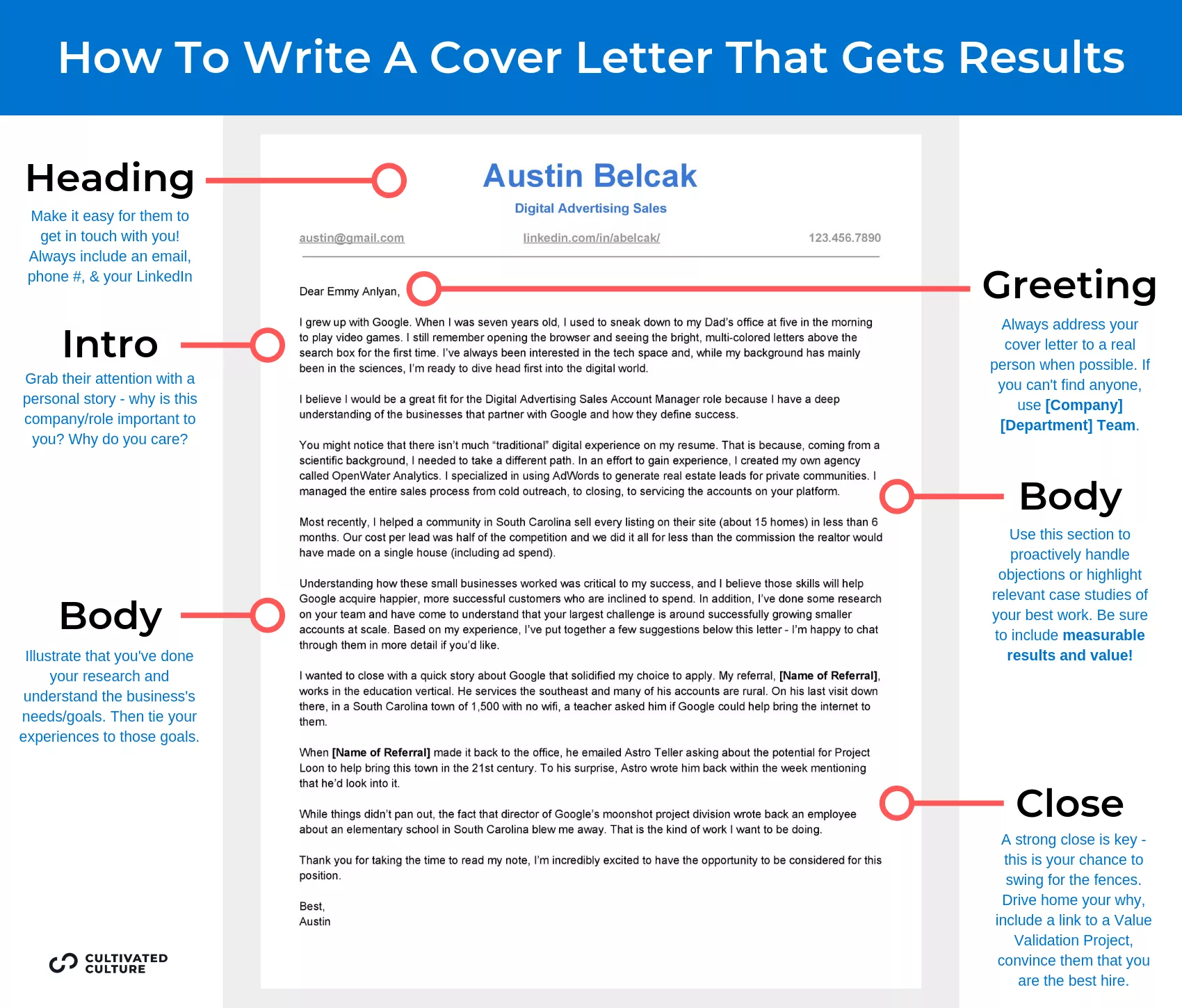
Curious about how to open a cover letter without having the name of your recipient? Start by including a professional salutation and immediately mention your relevant skills, experience, and interest in the job you’re applying for.
Select Professional Greetings That Keep Your Application Formal
Writing a first sentence in a cover letter could become awkward when you do not know the name of the person who will be looking through your resume and cover letter. Applicants fear that starting off with a general greeting will give the impression of not being serious about the job.
But a cover letter without a name may start with a professional approach too. The key is to select a good salutation that will lead to an introduction that highlights how the skills of the applicant match the requirements for the position.
Rather than making assumptions about the name or using informal salutations, applicants can use more professional approaches.
An engaging introduction could demonstrate attention to detail, self-assurance, and true interest in the role despite not knowing who the hiring manager is.
Start With A Professional Greeting
The best way forward is not to guess what the recruiter’s name might be. A mistake in addressing the person may leave a worse impression than the proper salutation.
Candidates can start their letters with greetings like “Dear Hiring Manager” or “Dear Recruitment Team.” These greetings are very professional and are aimed directly at the relevant people.
An introduction to a cover letter without a name doesn’t have to be impersonal. It just needs to create a polite tone of address. And from there, you can instantly personalize your cover letter by mentioning the job and how you became interested in it.
Match The Greeting To The Company Culture
Every organization has its own mode of communication. A traditional financial organization may require a more formal tone of communication, while a creative or technology organization may have a more informal one.
The applicant can consider the tone of the wording in the job advertisement when determining the right salutation. If the tone in the advertisement is extremely formal, then “Dear Hiring Manager” can be appropriate. However, where there is a friendly yet professional tone in the job advertisement, “Dear Recruitment Team” can be more effective.
However, while writing a cover letter without a name, the applicant must use a professional tone in the cover letter. An informal salutation should not make the whole cover letter informal.
Make The Application Stand Out With Relevant Research
The lack of knowledge of the hiring manager’s name is not an indicator that the cover letter will be generic.
Candidates can look through the company’s website, its recent projects, offered services, and products, etc. Even one piece of information will be enough to make the introduction feel carefully prepared.
A CV writing service can further help applicants present their experience through their CV and cover letters. They assist in creating a cover letter that is customized for the particular position and is not just a copy-pasted one from previous applications.
Turn The First Line Into A Strong Introduction
Following the introduction, the next sentence must provide a good reason to read further.
Weak opening statements usually involve broad remarks like being enthusiastic about job openings. However, a better technique would involve relating to the particular position that is advertised.
A cover letter without a name will be much more effective when the introduction to the letter provides quick answers to three key questions:
- What position the person is applying for
- What experience he or she has
- Why the candidate finds it interesting
The introduction may also assist recruiters in understanding the application, especially when there are multiple applications for the same position.
Capture Employer Interest Without Relying On Standard Patterns
Many cover letters start with the cliched statement, “I am writing to apply for the position.” This may be okay, but it fails to provide the reader with any compelling reason to read further.
It is better to open up with a relevant accomplishment, skill, or experience of the applicant.
While composing a cover letter without a name, the candidate can make the first paragraph catchy with facts as compared to making bold statements.
It must be kept short. Two or three sentences are sufficient to set the stage for the applicant’s credentials and relevance to the position.
Craft Respectful Opening Lines That Sound Natural
Some applicants go too far when they don’t know the name of the recruiter. They can come up with formulations that are outdated and excessively formal.
The use of a simple salutation is always better. The term “Dear Hiring Manager” is one that works well since it clearly states who the message is for without making an assumption.
The cover letter that does not have a person’s name on it should not have words like “To Whom It May Concern” unless there is some compelling reason to use them, since it can be less direct than a proper salutation.
Improve Your Application With Expert Career Support
Some of the candidates have a clear understanding of what to write in their applications, but cannot organize their experience effectively enough.
A cover letter writing service can be effective in improving structure, word choice, clarity, and presentation. It can help candidates prepare a relevant letter according to the position.
The candidate must still be honest regarding their experience, skills, accomplishments, and goals. Professional help is most effective when the application process maintains its honesty and portrays the true background of the applicant.
FAQs
Will it be appropriate to write a cover letter without a name?
Yes. A cover letter without a name will still be professional when it is written using an adequate greeting phrase like “Dear Hiring Manager” and then continues with a concise introduction where the applicant tells about their experience and understanding of the employer’s needs.
Is “Dear Hiring Manager” an appropriate cover letter greeting?
Yes, if you cannot find out the name of the recipient, “Dear Hiring Manager” is a clear and adequate option for addressing the recipient. It clearly states whom the letter is addressed to without assuming anything.
How can a professional cover letter without a name grab attention?
The application can stand out because of an interesting opening statement with the mention of achievements, skills, and value the applicant can provide. The way one can contribute to the company’s success counts more than any kind of personalized line of greeting to a recruiter.
Why should people refrain from using “To Whom It May Concern”?
“To Whom It May Concern” seems old-fashioned, cold, and very formal in today’s business environment. It is not very relevant to use in a cover letter.
Is it unprofessional to write a cover letter without a name?
Absolutely not; that is totally fine. Most of the time, the job posting doesn’t have any names at all, so a professional salutation can work better.
Conclusion
Going through the process of applications without being aware of the identity of the recruiting manager is a familiar problem for today’s job applicants.
By avoiding outdated language, using savvy digital research skills, and targeting particular departmental teams, candidates will be able to begin their applications with absolute confidence.
Being able to write a cover letter without a name ensures that your application is professional, captivating, and very convincing, and enables you to receive invitations for interviews and move ahead with your career aspirations.