

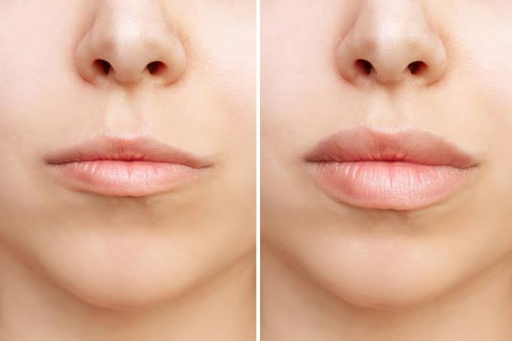
Two people can receive the same amount of filler and walk away with completely different lips. The difference is rarely the product. It comes down to where each drop goes and how that choice fits the anatomy underneath.
Understanding lip structure makes consultations easier and helps explain why experienced injectors talk about balance before they talk about volume. This guide breaks down how lip filler placement differs between the upper and lower lip and why those differences matter.
The Upper Lip: Shape, Definition, and Restraint
The upper lip is defined by the cupid’s bow, the sharp border where lip meets skin, and two vertical ridges called philtral columns running to the nose. Small adjustments here create a visible change. A little product along the border can sharpen a blurred outline, while a touch at the peaks of the bow can restore a lost curve.
The upper lip also tolerates less. It sits closer to the nose and tends to tip forward when overfilled, creating the shelf-like look people describe as a duck lip. Careful lip filler placement in this area favors small amounts, precise points, and patience between sessions.
The Lower Lip: Where Volume Lives
The lower lip is usually fuller, with more room to hold product and a gentler curve. Many injectors aim for a lower lip that is somewhat larger than the upper, a proportion often cited as roughly one to one and a half or one to one and six-tenths. It is a guideline rather than a rule, and natural variation is wide.
Because the lower lip moves more during speech and eating, injectors also consider how product will behave in motion. Soft, flexible fillers placed at the right depth tend to settle with the lip instead of forming a firm spot. Anyone exploring the technique behind lip filler placement can see how One Seventy Med Spa approaches the upper and lower lip in its comparison of each area.
Balance Beats Volume
Faces are read as a whole, which is why lip filler placement should always be judged against the nose, chin, and midface. Lips that are large for the chin, nose, and midface look out of place regardless of how smoothly the product was injected. A thorough assessment looks at profile and smile, not just a front view, and checks how much lip shows at rest and in conversation.
Asymmetry deserves attention too. Most people have one side slightly different from the other, and perfect mirror images can look artificial. The goal is to reduce distracting differences while leaving the natural character of the mouth intact.
Reversibility and Why It Matters
Most lip products are made from hyaluronic acid, which is reversible. A published scoping review of hyaluronidase use describes cross-linked hyaluronic acid as the most commonly used reversible filler in aesthetic medicine and notes that dissolving it is more likely to succeed when done early. That safety net is one reason conservative first treatments are widely recommended.
A measured approach has a practical side as well. Starting modestly lets you see how your lips heal, how long the product lasts for your body, and whether you want more. Adding is simple. Subtracting takes an extra procedure.
Healing, Longevity, and Maintenance
Swelling is common for the first few days, and lips can look larger than the final result. Bruising may appear. Most people see the settled outcome within about two weeks. Hyaluronic acid lip products often last somewhere between six and twelve months, depending on the product, the amount, and how quickly your body metabolizes it.
Thoughtful lip filler placement usually means smoother healing and more even fading. Schedule touch-ups before the product has fully faded. Maintaining a small amount is easier than rebuilding from zero, and it keeps results looking steady instead of rising and falling. Keep photos from your first visit to compare shape, symmetry, and balance over time.
Techniques Injectors Use to Refine the Lip
Placement is not a single method. Some injectors use a fine needle to place small deposits along the border, building definition point by point. Others use a blunt cannula to glide product through the body of the lip with fewer entry points, which can reduce bruising. Neither technique is universally better, and many practitioners use both depending on the area. The point is that lip filler placement is a plan, not a formula.
Depth matters just as much. Product placed too superficially can look lumpy or show a bluish tint, while product placed too deeply may not shape the lip. Expect the provider to explain where they intend to inject and why. A clear explanation of lip filler placement before treatment is a sign of experience and care.
Conclusion
Great lips come from understanding structure, not from chasing volume. The upper lip rewards restraint, the lower lip holds more, and the whole face sets the limits. Take that framework to your consultation, ask how lip filler placement will be tailored to your anatomy, and choose a provider who explains the plan before the first injection.