

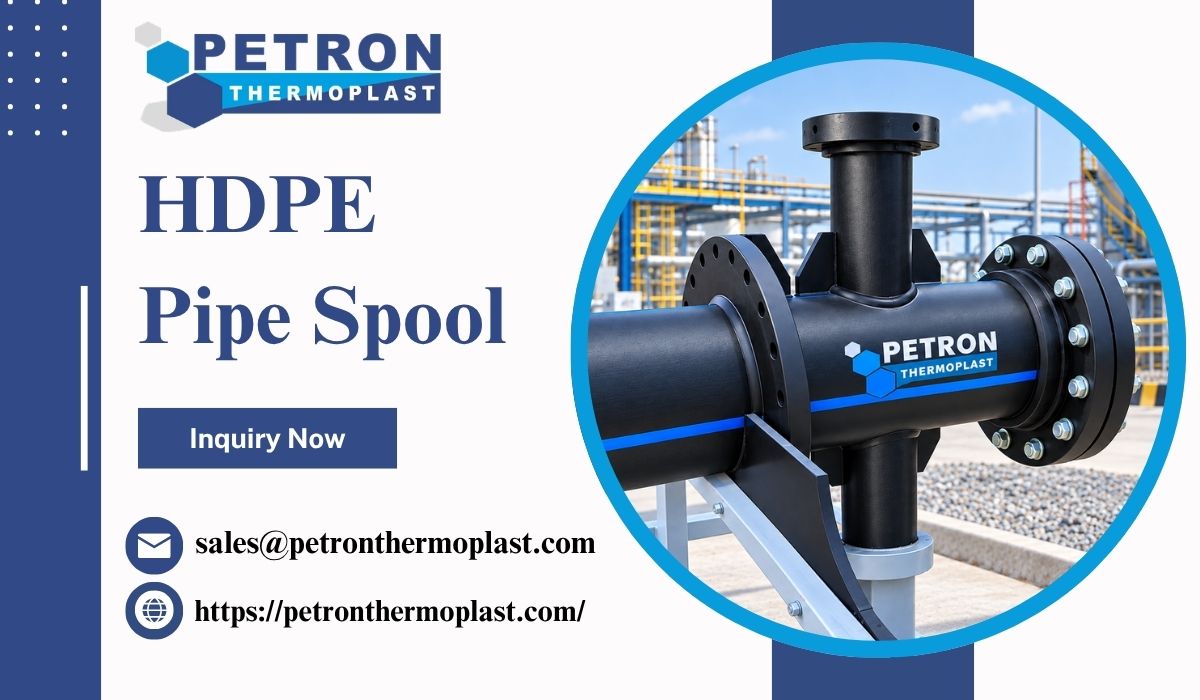
Industrial piping systems require reliable components that can withstand continuous operation, chemical exposure, pressure, and demanding installation conditions. In large-scale projects, prefabricated pipe sections can simplify installation and help improve project efficiency. HDPE Pipe Spool is one such solution, offering a practical way to prepare sections of piping according to project specifications before they are installed at the site.
HDPE, or High-Density Polyethylene, is a thermoplastic material widely used for industrial fluid transfer because of its chemical resistance, toughness, lightweight construction, and resistance to conventional corrosion. HDPE pipe spools can be fabricated in different lengths, sizes, and configurations to suit industrial piping requirements.
Petron Thermoplast provides thermoplastic piping products and fabricated solutions for chemical processing, water treatment, industrial manufacturing, and other applications where dependable fluid transfer is required.
What Is an HDPE Pipe Spool?
An HDPE Pipe Spool is a prefabricated section of HDPE piping manufactured according to a specific piping layout or project requirement. Instead of assembling every section of a pipeline at the installation site, pipe spools can be fabricated and prepared in advance.
A spool may include a straight pipe section along with fittings, branches, bends, flanges, reducers, valves, or other components depending on the design. The use of prefabricated spools can simplify site installation and help maintain consistency across large piping projects.
Why Choose HDPE for Pipe Spools?
HDPE has several properties that make it suitable for industrial piping applications. One of the main advantages is its resistance to corrosion. Unlike many metallic pipes, HDPE does not rust, making it useful in wet and corrosive environments.
Other important properties include:
- Good resistance to many chemicals
- Corrosion-resistant construction
- High toughness and impact resistance
- Lightweight compared with many metal piping systems
- Low moisture absorption
- Good abrasion resistance
- Smooth internal surface
- Long service life when correctly specified
- Flexible piping characteristics
Advantages of Prefabricated HDPE Pipe Spools
Fabricating pipe sections before installation can offer several benefits for industrial projects.
Faster Site Installation
Pre-fabricated pipe spools can reduce the amount of cutting, fitting, and joining required at the project site. Sections can arrive prepared according to the approved piping layout.
This can help improve installation efficiency, especially on large projects.
Consistent Fabrication
Controlled fabrication conditions can help maintain consistency in dimensions, joints, and fitting arrangements.
Reduced Site Work
By completing more fabrication work before delivery, the amount of site-based fabrication can potentially be reduced.
Easier Project Planning
Spools can be fabricated according to drawings, dimensions, and piping schedules. This can help project teams plan transportation and installation activities.
Reduced Material Handling
Pre-assembled sections can reduce the need to handle individual fittings and pipe components repeatedly during installation.
HDPE Pipe Spool Fabrication Process
The fabrication process should be controlled carefully to achieve reliable piping assemblies.
Design and Drawing Review
The first step is reviewing project drawings, dimensions, pipe sizes, connection details, and spool configurations.
Material Selection
The HDPE grade and pipe specifications should be selected according to the intended application, pressure, temperature, chemical exposure, and relevant project requirements.
Cutting
HDPE pipes are cut to the required dimensions using suitable equipment to achieve clean and accurate ends.
Fitting Preparation
Required elbows, tees, reducers, flanges, and other components are prepared according to the spool drawing.
Joining
HDPE components can be joined using appropriate methods such as butt fusion or electrofusion, depending on the pipe and fitting design.
Inspection
Completed spools should be inspected for dimensions, joint quality, alignment, and visible defects before dispatch.
How to Select the Right HDPE Pipe Spool?
Several technical factors should be evaluated before ordering a pipe spool.
Pipe Diameter
Determine the required pipe diameter and wall thickness based on the system design and flow requirements.
Pressure Rating
The pipe and spool assembly should be suitable for the system’s operating and design pressure. Pressure capability can vary with temperature, pipe dimensions, material grade, and joining method.
Temperature
HDPE performance depends on operating temperature. The selected pipe spool should be suitable for the actual process temperature.
Chemical Compatibility
Identify the exact chemical or fluid being transferred. HDPE resistance varies depending on the fluid, concentration, temperature, and exposure conditions.
Connection Requirements
Confirm whether the spool requires flanged, fused, threaded, or other connections.
Dimensions
Accurate dimensions are essential for proper site installation. Spool length, branch location, bend angles, and connection positions should match the approved drawings.
HDPE Pipe Spool vs. On-Site Fabrication
Traditional piping installation may involve cutting and joining individual pipe sections at the project site. While this approach can work for many projects, prefabricated spools offer another option.
With pipe spools, more fabrication work is completed before delivery. This can reduce site fabrication activities and help project teams manage installation more efficiently.
However, the best approach depends on project size, site conditions, transportation limitations, piping complexity, and installation requirements.
Installation Considerations
Proper handling and installation are essential for maintaining spool integrity. HDPE pipe spools should be transported and stored carefully to avoid damage.
During installation, ensure that the pipe supports and alignment are appropriate for the system. Avoid excessive mechanical stress at connections.
Thermal expansion and contraction should be considered during system design because HDPE has a higher coefficient of thermal expansion than many metal piping materials.
Joining procedures should follow suitable manufacturer and project guidelines. Completed joints should be inspected and tested as required before the pipeline is placed into service.
Maintenance of HDPE Pipe Spools
HDPE generally requires less corrosion-related maintenance than many metallic piping systems. However, regular inspection remains important.
Maintenance teams should check for:
- Visible cracks or damage
- Leakage at joints
- Unsupported pipe sections
- Excessive deformation
- Abrasion in demanding applications
- Damaged flange connections
- Changes in operating conditions
Why Choose Petron Thermoplast?
Petron Thermoplast provides thermoplastic piping products and fabricated solutions for industrial applications. Our product range includes HDPE, PVDF, CPVC, UPVC, PPH, and other thermoplastic products.
As an HDPE Pipe Spool Manufacturer, Petron Thermoplast can support industrial requirements involving prefabricated piping sections, chemical transfer systems, water treatment, wastewater handling, and other suitable applications.
Pipe spools can be planned according to project requirements, including pipe dimensions, fitting configurations, branch connections, flange arrangements, and spool lengths. Customers can share project drawings, specifications, pipe sizes, operating conditions, and quantity requirements to discuss suitable HDPE spool solutions.
Conclusion
HDPE Pipe Spool provides a practical solution for industrial piping projects that require prefabricated and application-specific piping sections. HDPE offers useful properties such as chemical resistance, corrosion resistance, toughness, lightweight construction, and abrasion resistance for suitable applications.
Prefabricated pipe spools can also help reduce site fabrication work, simplify installation, and support better project planning. The correct spool should always be selected according to pipe size, pressure, temperature, chemical compatibility, connection type, dimensions, and installation conditions.
If you are looking for a reliable HDPE Pipe Spool Manufacturer, contact Petron Thermoplast for customized spool configurations, technical requirements, bulk orders, and industrial piping solutions.