

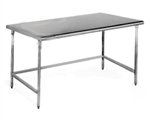
Choosing the right cleanroom table surface is essential when you need to control contamination, handle chemicals, and maintain a reliable working environment. The wrong material can develop scratches, discoloration, cracks, or surface damage after repeated exposure to cleaning agents and laboratory chemicals. These defects can make cleaning more difficult and create potential locations for contamination to accumulate.
To select the right surface, evaluate chemical compatibility, particle resistance, cleanability, durability, and your daily operating conditions. By comparing these factors before purchasing, you can choose a workstation that supports your cleaning procedures, protects sensitive materials, and provides long-term value.
Understand Your Cleanroom’s Operating Conditions
Before comparing materials, identify how your team will use the table. A surface suitable for electronics assembly may not be appropriate for chemical preparation or pharmaceutical applications.
Start by reviewing:
Chemical exposure: Identify disinfectants, solvents, acids, alkalis, and other substances used in your workflow.
Particle control: Determine how strictly you must limit particles, fibers, and surface debris.
Cleaning frequency: Establish how often the table will be wiped, disinfected, or exposed to cleaning solutions.
Workload: Consider equipment weight, sharp tools, sample containers, and repetitive handling.
Environmental conditions: Account for humidity, temperature, and any special cleanliness requirements.
These details help you eliminate unsuitable materials before comparing their individual properties.
Compare Common Cleanroom Table Surface Materials
Different surface materials offer different levels of chemical resistance, durability, and contamination control. Always verify the specific grade, finish, and manufacturer’s compatibility data rather than relying on the material name alone.
Stainless Steel
Stainless steel is a popular choice for cleanrooms because it provides a durable, nonporous surface that is generally easy to clean. It can withstand many routine cleaning procedures and is suitable for applications requiring repeated disinfection.
However, its resistance depends on the alloy, finish, chemical concentration, temperature, and contact time. Certain chlorides, aggressive acids, or prolonged chemical exposure can cause corrosion or surface damage.
Best suited for: Cleanrooms, laboratories, and production environments requiring durable surfaces and frequent cleaning.
Phenolic Resin
Phenolic resin surfaces are commonly used for laboratory workbenches because they offer useful resistance to many chemicals and provide a practical working surface.
Their performance depends on the resin formulation and the chemicals involved. Strong oxidizers, prolonged exposure, excessive heat, or incompatible solvents may damage some products.
Best suited for: Laboratory preparation, general chemical handling, and workstations that require a balance of chemical resistance and practical maintenance.
High-Pressure Laminate and Other Coated Surfaces
Laminated or coated surfaces may provide a smooth, easy-to-maintain work area at a competitive cost. However, their suitability depends on the coating chemistry, edge construction, and resistance to repeated cleaning.
Scratches, chipped coatings, damaged seams, or exposed substrate material can compromise cleanability and allow moisture or chemicals to penetrate.
Best suited for: Controlled environments with moderate chemical exposure, provided the selected product meets the required cleanliness and durability specifications.
Polypropylene and Other Chemical-Resistant Plastics
Polypropylene and certain engineered plastics can provide strong resistance to specific acids, alkalis, and other chemicals. Their performance varies by chemical, concentration, temperature, and mechanical load.
Some plastics may scratch more easily, deform under heat, or release particles when damaged. Confirm that the complete table construction—not just its top panel—is appropriate for your application.
Best suited for: Work areas involving compatible corrosive chemicals or specialized chemical-processing tasks.
Evaluate Chemical Resistance With Real-World Testing
A surface described as chemical-resistant is not necessarily compatible with every laboratory chemical. Compare the manufacturer’s chemical compatibility chart against your actual reagents and cleaning products.
Check these four factors:
Chemical concentration: A diluted solution may affect a surface differently from a concentrated chemical.
Contact time: Brief splashes and prolonged spills create different exposure conditions.
Temperature: Heat can change how a material responds to chemicals.
Repeated exposure: Daily cleaning can gradually damage an otherwise suitable surface.
When possible, request documented compatibility information and conduct a controlled evaluation using an approved procedure. Never test hazardous chemicals on an installed workstation without appropriate safety controls.
Assess Particle Resistance and Surface Cleanability
Chemical resistance alone does not guarantee suitability for a cleanroom. Your selected table must also support effective particle control.
Look for surfaces with these characteristics:
- Smooth, nonporous finishes that are easy to wipe.
- Minimal seams, crevices, and exposed edges.
- Durable surfaces that resist scratching and flaking.
- Construction that does not expose particle-generating substrates.
- Joints and fasteners that remain accessible for cleaning.
Stainless steel is often a practical option for demanding cleanroom applications because it is durable and easy to clean. However, the overall table design, surface finish, fabrication quality, and maintenance procedures also influence cleanliness.
If your process handles sensitive electronics, evaluate electrostatic discharge (ESD) requirements separately. A conductive metal table does not automatically provide a complete ESD-protected workstation; grounding and other system components must also meet your requirements.
Compare Cleanroom Table Surfaces at a Glance
| Surface material | Chemical resistance | Particle-control considerations | Typical application |
| Stainless steel | Depends on alloy and chemical exposure | Smooth, durable, and easy to clean | Cleanrooms and hygiene-sensitive work |
| Phenolic resin | Good against many common laboratory chemicals | Inspect edges and damaged areas | General laboratory work |
| Epoxy resin | Often suitable for demanding chemical and heat exposure | Nonporous when intact; protect against impact damage | Chemical laboratories |
| Polypropylene | Strong resistance to many compatible corrosive chemicals | Inspect scratches, joints, and structural wear | Specialized chemical-handling areas |
| Conventional laminate | Varies by formulation and coating | Damaged edges and seams may compromise cleanability | Lower-risk applications when specifications permit |
This comparison is a preliminary selection guide, not a substitute for product-specific compatibility data. Actual performance varies with material grade, construction, chemical exposure, and cleaning methods.
Consider Maintenance, Durability, and Total Cost
The lowest purchase price does not always provide the best long-term value. A surface that deteriorates under routine cleaning may require more frequent repairs, replacement, or downtime.
Evaluate the following before purchasing:
Maintenance requirements: Confirm approved cleaning agents and procedures.
Repairability: Determine whether scratches, chips, or corrosion can be addressed safely.
Expected service life: Consider daily usage, chemical exposure, and mechanical wear.
Replacement costs: Include installation, workflow interruptions, and disposal.
Structural integrity: Check load capacity, support frames, edges, and joints.
Explore the available cleanroom tables and laboratory workstations to compare configurations for your workspace. Choose a design that matches both your cleanliness requirements and your operational demands.
Create a Practical Surface Selection Checklist
Before finalizing your purchase, document the requirements that matter most to your facility.
- List all process chemicals and cleaning agents.
- Confirm compatibility with their concentrations and contact times.
- Define particle-control and cleanliness requirements.
- Evaluate scratch, impact, moisture, and heat resistance.
- Inspect edges, joints, seams, and undersides for cleanability.
- Confirm load capacity and any ESD requirements.
- Review manufacturer specifications and maintenance instructions.
For additional information about laboratory and cleanroom solutions, visit CleaTech LLC. Comparing the full workstation design—not just its tabletop—helps you make a more reliable purchasing decision.
Conclusion
Comparing cleanroom table surfaces requires more than choosing a material labeled chemical-resistant. You must consider your actual chemical exposure, particle-control requirements, cleaning procedures, mechanical demands, and long-term maintenance costs.
Stainless steel may be appropriate for frequent cleaning, phenolic resin for many general laboratory applications, epoxy resin for demanding work, and polypropylene for compatible corrosive chemicals. The right choice depends on your specific operating conditions and the manufacturer’s documented performance data.
Prioritize verified compatibility, smooth and cleanable construction, and durable materials to support consistent cleanroom operations.
Frequently Asked Questions
1. Which cleanroom table surface is best for chemical resistance?
There is no single best material for every chemical. Epoxy resin, phenolic resin, stainless steel, and polypropylene each suit different applications. Compare the exact chemical, concentration, temperature, and contact time against the manufacturer’s compatibility data.
2. Is stainless steel suitable for cleanroom particle control?
Yes, stainless steel is commonly used because its smooth, nonporous surface is easy to clean and durable. However, surface finish, fabrication quality, joints, and maintenance practices also affect particle control.
3. How do you prevent cleanroom table surfaces from generating particles?
Choose durable, smooth surfaces that resist flaking and abrasion. Avoid damaged coatings, exposed substrates, rough edges, and difficult-to-clean joints. Inspect workstations regularly and replace surfaces that can no longer be cleaned effectively.
4. Is phenolic resin better than stainless steel for laboratory tables?
Not necessarily. Phenolic resin can provide a practical balance of chemical resistance and durability for many laboratory tasks. Stainless steel is often preferred when frequent cleaning and hygiene are priorities. Your chemical exposure and cleanliness requirements should determine the selection.
5. How often should cleanroom table surfaces be inspected?
Inspection frequency should follow your facility’s risk assessment, cleaning schedule, and contamination-control procedures. Check for scratches, corrosion, cracks, damaged edges, and coating deterioration during routine inspections, and document any defects that could affect cleanability.