

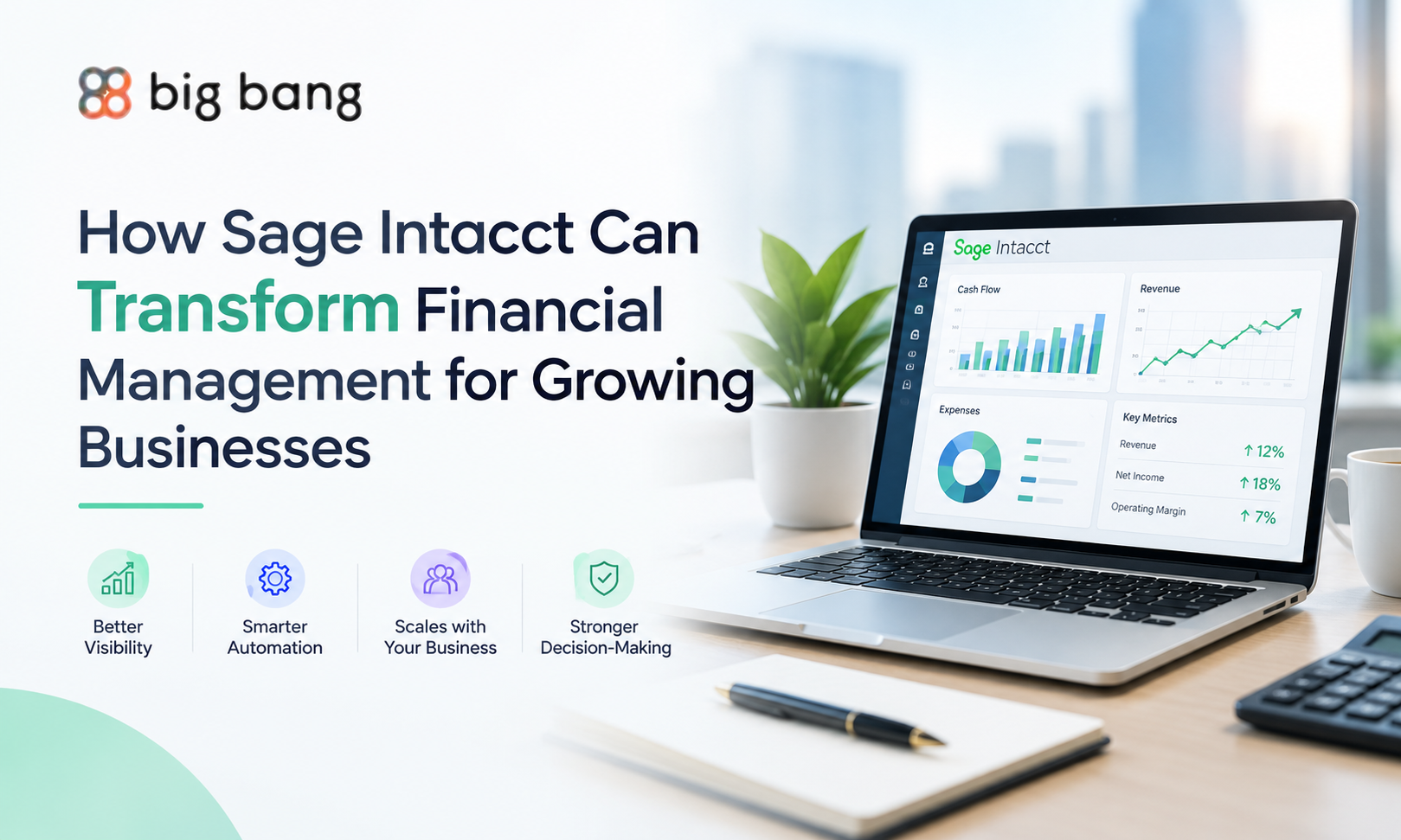
As a business grows, its financial management needs become more complicated. What works for a small company may no longer be effective when transaction volumes increase, new departments are added, multiple entities are introduced, or operations expand into new markets. Finance teams can find themselves relying on spreadsheets, disconnected applications, and repetitive manual processes simply to keep financial information organized.
This is where modern cloud-based financial management technology can make a significant difference. Sage Intacct is designed to help growing organizations automate core financial processes, improve visibility into business performance, and create a more connected financial environment. The platform offers capabilities across core financials, billing, budgeting and planning, reporting, integrations, and additional financial management functions.
However, choosing the right software is only one part of a successful digital transformation. Businesses also need to determine how the system should be configured, how existing information should be migrated, which applications should be connected, and how employees will use the new platform. Working with experienced ERP professionals can help businesses approach these decisions strategically.
Why Growing Businesses Need a Modern Financial System
Growth often creates complexity. A company may begin with a basic accounting system, but increasing customers, suppliers, transactions, employees, and reporting requirements can eventually expose limitations in the existing setup.
Manual data entry can consume valuable employee time, while information stored across different applications can make it difficult for management to obtain a complete picture of business performance. Preparing reports may require finance teams to collect and reconcile information from several sources.
A cloud financial management platform can help address these challenges by bringing important financial processes into a connected environment. Sage Intacct provides functionality for areas such as accounts payable, accounts receivable, cash management, general ledger, purchasing, order management, billing, budgeting, and reporting.
The objective is not simply to replace an old accounting system. A well-planned financial transformation can help create processes that are more efficient, scalable, and easier to manage as the organization continues to grow.
The Role of ERP Consulting in a Sage Intacct Project
Implementing an ERP solution affects more than the finance department. It can influence how information moves between departments, how employees complete everyday tasks, how management accesses reports, and how other business applications communicate with financial systems.
This makes professional erp consulting services valuable for organizations that want to get more from their technology investment. Consultants can help businesses evaluate their existing processes, identify areas for improvement, determine system requirements, and develop an implementation strategy that aligns technology with business objectives.
Big Bang’s Sage Intacct approach includes planning, consulting and strategy, implementation, and training. Its consultants combine industry knowledge with technical expertise to configure, test, and deploy solutions according to organizational requirements.
This type of guidance can help businesses avoid implementing technology without first understanding how it should support their broader operations.
Building a Financial System Around Business Processes
Every organization has its own workflows and reporting requirements. Two businesses in the same industry may still have very different approval processes, billing structures, reporting dimensions, and operational needs.
For this reason, implementing Sage Intacct should begin with an understanding of how the business currently operates. Consultants can review existing workflows and identify processes that should be automated, redesigned, or integrated with other applications.
The goal should be to create a system that works naturally for the organization rather than forcing employees to work around unnecessary system limitations. Big Bang emphasizes creating customized finance and accounting systems that automate and streamline accounting processes while adapting to the way teams need to work.
A process-focused implementation can also help businesses identify inefficient practices that may have become routine over time.
Making Financial Reporting More Useful
Access to accurate financial information is essential for effective decision-making. Business leaders need to understand revenue, expenses, cash flow, profitability, budgets, and operational performance without waiting for lengthy manual reporting processes.
Sage Intacct provides dashboards and reporting capabilities designed to give businesses faster access to financial and operational information. The platform can provide reporting across multiple dimensions and consolidated entities, helping decision-makers access relevant information when they need it.
Improved reporting can have a practical impact on everyday management. Instead of spending excessive time preparing information, finance teams can spend more time analyzing results and supporting strategic decisions.
Automating Repetitive Financial Processes
Repetitive financial tasks can create unnecessary administrative work. Processes such as procure-to-pay, order-to-cash, billing, budgeting, and financial administration often involve multiple steps that can be streamlined through automation.
Sage Intacct provides automation capabilities across important finance processes. Its functionality includes accounts payable, accounts receivable, cash management, billing, purchasing, order management, and budgeting and planning.
Automation can help reduce manual work and improve consistency. It can also allow finance professionals to focus more attention on analysis, planning, and business support rather than spending most of their time processing routine transactions.
Connecting Sage Intacct With Other Business Applications
Modern businesses typically depend on several software platforms. A company might use a CRM for customer management, a professional services platform for project operations, or specialized applications for other departments.
When these systems operate independently, employees may have to enter the same information more than once. This can create duplicate work and increase the possibility of data inconsistencies.
Sage Intacct has integration capabilities that allow financial information to connect with other business solutions. Big Bang specifically highlights integrations with platforms such as Salesforce and other applications through available integration technologies and APIs.
Professional guidance becomes particularly important when designing these connections. Poorly planned integrations can affect reporting, dashboards, data extraction, and other critical financial functions. A structured integration strategy can help ensure that systems communicate effectively while protecting the integrity of financial information.
Why Sage ERP Implementation Requires Careful Planning
Technology implementation should never be treated as a simple software installation. A successful sage erp implementation requires planning around business processes, configuration, data, integrations, testing, and user adoption.
Before implementation begins, businesses should establish what they want the new system to accomplish. They should also identify existing challenges and determine which processes should change after the new platform is introduced.
During implementation, system configuration should reflect business requirements while avoiding unnecessary complexity. Testing should then confirm that workflows, reports, integrations, and other important functions operate as expected.
Training is another important component. Employees need to understand not only how to use the platform but also how their responsibilities may change within the new processes.
Taking a structured approach can make the transition smoother and help businesses achieve value from the system sooner.
Supporting Multi-Entity and Growing Organizations
Growth can introduce additional financial complexity when a business adds subsidiaries, locations, departments, or international operations. Managing financial information across multiple entities can become difficult when systems are not designed to support consolidated reporting.
Sage Intacct provides advanced functionality that includes multi-entity and global consolidations, along with other capabilities such as project accounting, inventory management, fixed assets, revenue recognition, and spend management.
This flexibility can be valuable for organizations that expect their financial requirements to evolve. Instead of building a completely new system every time the business expands, organizations can use a configurable cloud platform designed to accommodate changing requirements.
Choosing the Right Sage Intacct Consultant
The implementation partner can play an important role in determining how effectively a business adopts its new financial system. Companies should consider more than software knowledge when evaluating a consultant.
A capable sage intacct consultant should understand business processes, financial operations, system configuration, integrations, migration, testing, and training. They should also be able to communicate effectively with both technical teams and business stakeholders.
Big Bang states that its consultants support organizations through business system analysis, implementation, migration, development, integration, and training. The company also highlights its Sage Intacct certifications and experience across consulting and implementation services.
Having access to this combination of technical and business expertise can help organizations make more informed decisions throughout the project.
Training and User Adoption Matter
Even the most capable ERP platform cannot deliver its full value if employees do not use it effectively. User adoption should therefore be considered from the beginning of the project.
Training can help employees understand new workflows, reporting tools, approval processes, and financial functions. It can also reduce uncertainty during the transition from an existing system to Sage Intacct.
Big Bang offers training through certified consultants as part of its Sage Intacct services.
When users understand how the new system supports their daily responsibilities, organizations are more likely to see long-term improvements in productivity and process consistency.
Sage Intacct as a Foundation for Future Growth
One of the important advantages of a cloud-based financial management platform is adaptability. Growing organizations need systems that can change alongside their operations rather than becoming another limitation.
Sage Intacct uses a modular cloud architecture that allows businesses to add functionality as their requirements develop. The platform includes core financial management as well as optional capabilities covering areas such as advanced functionality, billing, planning, integrations, and reporting.
This makes it possible for organizations to approach financial technology as a long-term investment rather than a short-term solution.
How Big Bang Can Support Sage Intacct Transformation
Big Bang provides Sage Intacct consulting and implementation services designed to support businesses throughout their financial transformation. Its services cover strategy and planning, implementation, integration, migration, customization, training, and ongoing support.
The company’s approach focuses on understanding the organization’s requirements and configuring the platform accordingly. It also emphasizes helping businesses integrate Sage Intacct with other applications and establish financial processes that can support future growth.
For organizations considering Sage Intacct, working with an experienced implementation partner can provide the guidance needed to move from software selection to a properly configured and usable financial management environment.
Conclusion
As businesses expand, financial management becomes increasingly important to operational efficiency and strategic decision-making. Outdated systems, disconnected applications, and manual processes can make it difficult for finance teams to keep pace with changing requirements.
Sage Intacct offers a cloud-based approach to financial management with capabilities covering core accounting, automation, reporting, billing, budgeting, integrations, and advanced financial functions.
However, the technology itself is only part of the equation. Careful planning, appropriate configuration, integration, testing, and employee training are all essential to achieving a successful implementation.
With the right strategy and professional guidance, Sage Intacct can become more than an accounting platform. It can provide a scalable financial foundation that helps organizations improve visibility, automate important processes, make better decisions, and prepare for continued growth.
Frequently Asked Questions
What is Sage Intacct?
Sage Intacct is a cloud-based accounting and financial management solution designed to help organizations manage core financial processes, reporting, billing, budgeting, and other business functions.
Why are ERP consulting services important?
ERP consulting can help businesses understand their requirements, improve processes, plan implementation, configure the system, manage integrations, and train employees. This can reduce implementation challenges and improve the overall value of the ERP investment.
What does Sage Intacct implementation involve?
A Sage Intacct implementation can involve business analysis, planning, system configuration, data migration, integrations, testing, deployment, and employee training. The exact process depends on the organization’s size, existing systems, and business requirements.
Can Sage Intacct integrate with other business software?
Yes. Sage Intacct offers integration capabilities and can connect with other business applications. Big Bang highlights integration with platforms such as Salesforce as part of its Sage Intacct capabilities.
How can a Sage Intacct consultant help a growing business?
A Sage Intacct consultant can help evaluate business processes, configure the platform, plan integrations, support migration and implementation, provide training, and recommend approaches that align the system with the organization’s current and future requirements.