

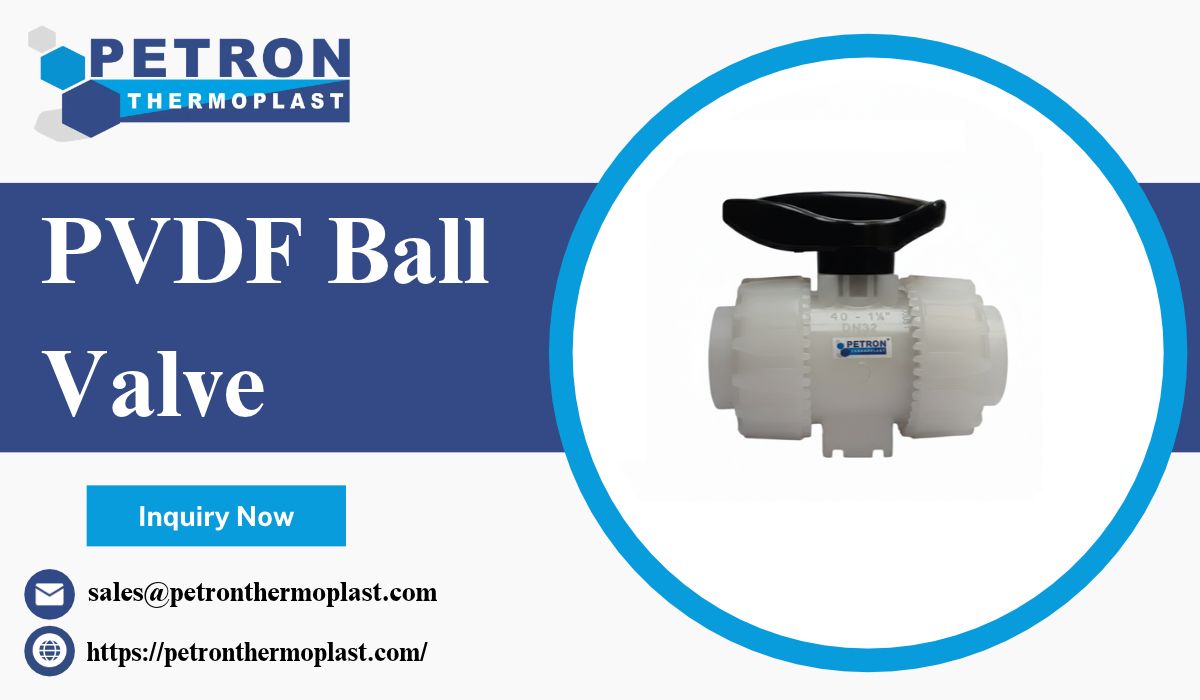
Large industrial pipeline networks require reliable valves to control liquid movement, isolate pipeline sections and support efficient plant operations. In chemical processing and other demanding industries, selecting the right valve material is particularly important. Customized PVDF ball valve is considered for industrial applications where chemical resistance, reliable flow control and specific pipeline configurations are required.
PVDF (Polyvinylidene Fluoride) is an engineering thermoplastic known for its chemical resistance, mechanical properties and performance in selected demanding environments. PVDF ball valves are used in compatible chemical transfer, water treatment, pharmaceutical and industrial process applications.
For large pipeline networks, standard valve configurations may not always meet the installation requirements. Customized options can help match valve dimensions, connection arrangements and operating specifications with the project design.
What Is a PVDF Ball Valve?
A PVDF ball valve is a quarter-turn valve manufactured with a PVDF body and a rotating ball mechanism. The ball contains a central opening that controls the flow of liquid through the pipeline.
When the handle or actuator rotates the ball by approximately 90 degrees, the valve changes between open and closed positions. In the open position, the ball opening aligns with the pipeline. In the closed position, the solid section of the ball blocks the flow path.
PVDF ball valves are considered for applications where a suitable non-metallic valve is required. Their final suitability depends on the process fluid, chemical concentration, pressure, temperature and valve design.
Why Choose Customized PVDF Ball Valves for Large Pipeline Networks?
Large pipeline installations often connect several processing units, storage tanks, pumps and distribution lines. Each connection may have different dimensions and operating requirements.
Customized PVDF ball valves help address project-specific requirements.
- Chemical Resistance
PVDF offers resistance to many chemicals and is used in selected corrosive-fluid handling applications. This makes it an important material option for industries that require non-metallic piping components.
However, compatibility must always be checked for the exact chemical, concentration and operating temperature.
- Reliable On-Off Flow Control
The quarter-turn mechanism provides straightforward opening and closing operation. It helps operators isolate pipeline sections during maintenance and process operations.
- Lightweight Construction
PVDF valves are generally lighter than comparable metal valves. This can simplify handling and installation, although the overall pipeline support design must still be considered.
- Project-Specific Configurations
Customized valves can be evaluated according to required sizes, connection types, operating conditions and installation arrangements.
- Suitable for Selected Industrial Environments
PVDF is used in demanding industrial applications where chemical compatibility and material performance are important selection factors.
Types of PVDF Ball Valves
Different PVDF ball valve designs are available depending on the pipeline configuration and operational requirements.
- Two-Way PVDF Ball Valve
A two-way ball valve has one inlet and one outlet. It is commonly used for opening and closing flow through a pipeline section.
- Three-Way PVDF Ball Valve
A three-way configuration provides multiple flow paths. Depending on its internal ball design, it can be used to divert or select flow between connected pipeline sections.
- Flanged PVDF Ball Valve
Flanged valves are considered for installations where bolted connections are required. Flange dimensions, drilling patterns and pressure compatibility must match the pipeline design.
- Socket-End PVDF Ball Valve
Socket-end configurations are designed for compatible joining arrangements. The joining process must follow the manufacturer’s recommendations.
- Actuated PVDF Ball Valve
An actuator can be used to operate the valve automatically. Depending on the application, pneumatic or electric actuation may be considered for process automation.
Applications of PVDF Ball Valves in Industrial Pipeline Networks
PVDF ball valves are considered in several industries where compatible chemical-resistant flow control components are required.
Chemical Processing Plants
Chemical processing facilities handle different liquids during manufacturing and transfer operations. PVDF ball valves may be selected for compatible chemical pipelines where material resistance is essential.
Pharmaceutical Industries
Pharmaceutical manufacturing facilities use specialized process and utility systems. PVDF components may be considered in suitable applications where chemical compatibility and process requirements are satisfied.
Water Treatment Plants
Water treatment facilities use valves throughout filtration, purification and chemical dosing systems. PVDF ball valves can be considered for selected treatment lines and compatible chemical handling sections.
Semiconductor and Electronics Industries
Certain semiconductor manufacturing processes require specialized high-purity fluid handling systems. PVDF is used in some such applications, subject to the required material grade, cleanliness and system specifications.
Electroplating Industries
Electroplating facilities use different chemical solutions for surface treatment. Compatible PVDF ball valves may be considered for selected chemical transfer and circulation pipelines.
Industrial Chemical Storage Facilities
PVDF ball valves can be used in suitable tank inlet, outlet and transfer arrangements where the fluid and operating conditions are compatible with the valve.
Customization Options for Large Pipeline Projects
Large industrial projects may require different valve configurations throughout the same facility. Customization helps coordinate valve selection with the overall pipeline engineering design.
Important options include:
- Valve size: Selection according to the pipeline diameter and required flow capacity.
- Connection arrangements: Flanged, socket or other compatible connections.
- Valve operation: Manual or actuator-operated configurations.
- Sealing components: Selection based on the chemical and operating temperature.
- Pipeline integration: Compatibility with existing PVDF piping, fittings and equipment connections.
- Project quantities: Planning for multiple valves across different pipeline sections.
- Technical documentation: Drawings, datasheets and relevant product information.
How to Select the Right PVDF Ball Valve?
Choosing the correct valve requires careful evaluation of the complete pipeline system.
- Identify the Process Fluid
Provide the chemical name, concentration and any relevant mixture details. This information is essential for material compatibility assessment.
- Confirm Operating Pressure
Check normal operating pressure, maximum pressure and any potential pressure variations within the pipeline.
- Evaluate Temperature Conditions
Review the minimum, normal and maximum operating temperatures. PVDF valve performance depends on the temperature and pressure conditions.
- Select the Correct Valve Size
The valve size should match the pipeline design and required flow capacity. A larger valve is not automatically the better option.
- Choose the Connection Type
Confirm the connection arrangement with the existing piping system, including flange dimensions where applicable.
- Consider Automation Requirements
For large pipeline networks, automated operation may help manage valves in difficult-to-access locations or integrated process systems.
- Review Product Documentation
Request technical datasheets, dimensional drawings and applicable test information before approving the valve for installation.
Advantages of PVDF Ball Valves for Bulk Industrial Projects
For large industrial facilities, consistent valve specifications can simplify purchasing, installation planning and maintenance.
Key benefits include:
- Suitable options for selected corrosive-fluid applications.
- Compact quarter-turn operation.
- Lightweight non-metallic construction.
- Different connection and operating configurations.
- Integration with compatible industrial plastic piping systems.
- Options for customized project requirements.
- Support for bulk procurement and planned installations.
Why Choose Petron Thermoplast?
Petron Thermoplast focuses on industrial plastic piping products, valves, fittings and customized solutions for different industrial requirements.
For PVDF ball valve enquiries, customers can share their required valve size, connection type, operating conditions and application details. These specifications help evaluate suitable product configurations for the intended pipeline network. Petron Thermoplast supports industrial and bulk project enquiries, including requirements for customized plastic piping components.
Whether you are planning a new chemical processing facility, expanding an existing pipeline network or replacing existing valves, sharing the technical details helps identify suitable options.
Bulk Supply and Export Requirements
Large pipeline projects often require multiple valves with consistent specifications. Planning quantities and configurations in advance helps coordinate procurement with the project schedule.
For bulk PVDF ball valve enquiries, provide the following information:
- Required valve sizes and quantities.
- Preferred connection type.
- Manual or actuated operation requirements.
- Chemical or liquid details.
- Operating pressure and temperature.
- Project drawings, if available.
- Delivery location and project timeline.
Conclusion
Customized PVDF ball valves are an important option for industrial pipeline networks that require suitable chemical resistance and reliable on-off flow control. Their applications include chemical processing, water treatment, pharmaceutical manufacturing and other compatible industrial fluid-handling systems.
Selecting the right valve requires careful consideration of material compatibility, pressure, temperature, valve size, connection type and operating mechanism. Petron Thermoplast supports industrial plastic piping and customized valve enquiries for bulk project requirements. Contact the team with your specifications to discuss suitable PVDF ball valve solutions for your next pipeline installation.