

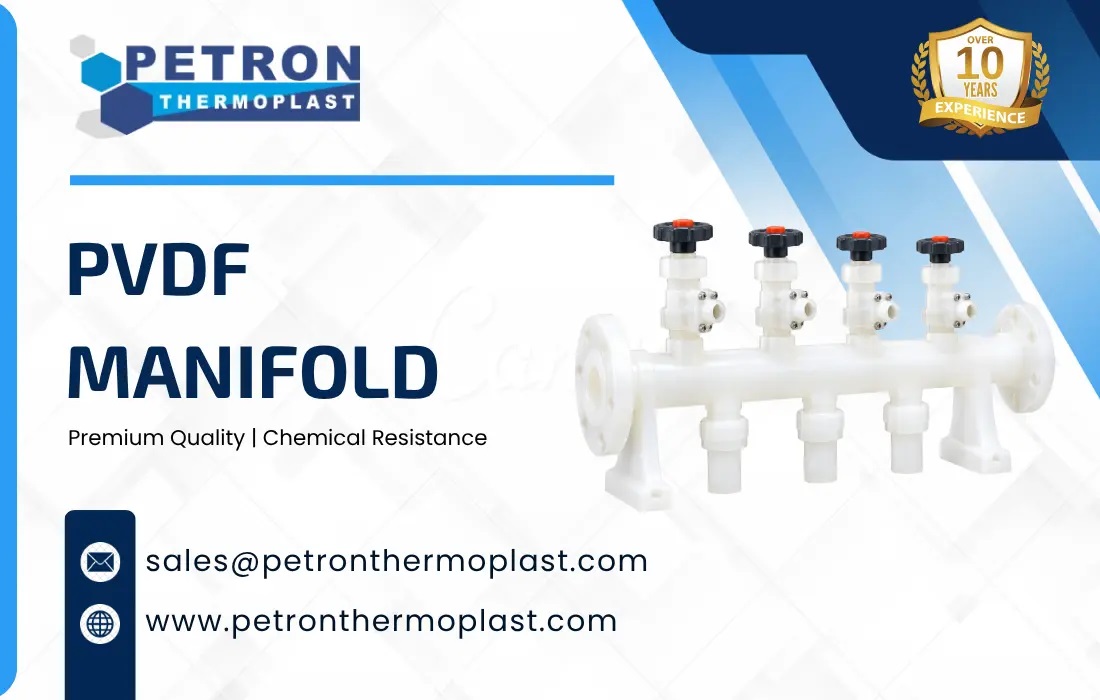
Chemical processing plants require reliable piping components to manage the movement and distribution of aggressive chemicals, process fluids, and specialized liquids. Every component in a chemical distribution system must be selected according to the operating pressure, temperature, chemical compatibility, and required flow rate. A PVDF manifold is an effective solution for applications that need corrosion-resistant fluid distribution and dependable performance under suitable operating conditions.
PVDF, or Polyvinylidene Fluoride, is a high-performance thermoplastic known for its chemical resistance, mechanical strength, and thermal stability. PVDF manifolds are used to distribute fluids between multiple pipelines, connect process equipment, and organize complex fluid-handling arrangements.
Petron Thermoplast offers thermoplastic piping solutions for industrial applications, including PVDF manifold requirements based on project specifications. Customized manifold configurations can help chemical processing plants develop piping systems that suit their operational needs.
What Is a PVDF Manifold?
A PVDF manifold is a specially designed piping component that connects one main fluid line to multiple outlets or combines several incoming lines into a common outlet. It helps distribute or collect fluids within an industrial process system.
Manufactured using PVDF material, these manifolds are suitable for selected chemical handling applications where corrosion resistance and material compatibility are important. Depending on the system design, a PVDF manifold may include multiple branches, inlet and outlet connections, threaded or flanged interfaces, and provisions for valves or instrumentation.
The final configuration depends on the fluid characteristics, number of connection points, available installation space, flow requirements, and process conditions.
Why Choose PVDF Manifolds for Chemical Processing Plants?
Chemical processing environments can expose piping components to aggressive substances, fluctuating temperatures, and demanding operating conditions. PVDF offers several advantages when the material is correctly selected for the application.
- Excellent Chemical Resistance
One of the major advantages of PVDF is its resistance to a wide range of chemicals. It is used in suitable applications involving acids, bases, solvents, and other industrial fluids.
However, chemical resistance varies according to the specific chemical, concentration, temperature, exposure duration, and mechanical stress. Compatibility should always be verified before selecting a PVDF manifold for a particular process.
- Corrosion-Resistant Construction
Unlike conventional metal components, PVDF does not rust. This property makes it a useful option for compatible chemical distribution systems where metallic corrosion could increase maintenance requirements or affect process reliability.
- Good Thermal Stability
PVDF can perform across a useful range of operating temperatures. Its suitability depends on the grade, manifold design, pressure, and chemical environment.
When temperature and pressure increase, the allowable working pressure may decrease. Both factors must be considered during system design.
- Mechanical Strength
PVDF offers a combination of mechanical strength and rigidity that supports its use in industrial piping systems. Properly designed manifolds can provide dependable service when operated within the manufacturer’s specified limits.
- Low Maintenance Requirements
Because PVDF is resistant to corrosion in compatible environments, it may reduce maintenance associated with rust and chemical attack. Actual maintenance requirements depend on installation quality, operating conditions, and inspection procedures.
- Design Flexibility
PVDF manifolds can be configured for different inlet and outlet arrangements. Depending on manufacturing capabilities and project requirements, designs may accommodate multiple branches, different connection sizes, and specific installation dimensions.
Types of Custom PVDF Manifolds
Chemical plants use different manifold designs according to their process requirements. Common configurations include the following.
Single-Inlet Multiple-Outlet Manifold
This arrangement receives fluid through one inlet and distributes it across several outlets. It is useful when a single supply line must feed multiple process lines or equipment connections.
Multiple-Inlet Single-Outlet Manifold
This configuration collects fluid from several incoming lines and directs it into a common outlet. It may be considered for selected collection and process-transfer systems.
Multi-Port PVDF Manifold
A multi-port manifold includes several connection points within a compact arrangement. It can help reduce the number of separate piping connections and simplify installation in equipment areas with limited space.
Customized Process Manifold
A custom-designed manifold is developed according to project drawings, connection requirements, flow distribution needs, and available installation space. It may include different branch arrangements and compatible valve or instrument interfaces.
The appropriate design should be confirmed through engineering review rather than selected by port count alone.
Applications of PVDF Manifolds in Chemical Industries
PVDF manifolds can support several industrial processes when the material is compatible with the fluid and operating conditions.
Chemical Manufacturing Plants
Chemical manufacturers may use PVDF manifolds to distribute compatible process chemicals between reactors, storage systems, dosing lines, and other process equipment.
Acid Handling Systems
Certain acid-transfer applications can benefit from PVDF’s chemical resistance. The exact acid type, concentration, temperature, and pressure must be reviewed before selecting the manifold.
Pharmaceutical Manufacturing
PVDF may be used in selected pharmaceutical process and utility applications where the material meets the required chemical compatibility, cleanliness, and regulatory specifications.
Water Treatment Facilities
Industrial water treatment plants may use PVDF manifolds in selected chemical dosing and fluid distribution systems. These applications can include handling compatible treatment chemicals.
Semiconductor and Electronics Industries
Certain high-purity process systems use PVDF components because of their chemical resistance and suitability for specific fluid-handling requirements. The required material grade, cleanliness, and connection method should be confirmed for each application.
Electroplating and Surface Treatment
Electroplating and metal surface treatment facilities may handle corrosive process solutions. PVDF manifolds can be considered where the material is compatible with the chemicals and operating environment.
Important Factors When Selecting a Custom PVDF Manifold
Selecting the correct manifold requires more than choosing a material. Buyers and engineers should review several technical factors before confirming a design.
Chemical compatibility: Identify the exact fluid, concentration, and expected exposure conditions.
Operating pressure: Confirm the working pressure and any pressure variations or surges within the system.
Operating temperature: Evaluate the normal and maximum process temperatures and their effect on pressure capability.
Number of ports: Determine how many inlet, outlet, and branch connections are required.
Connection type: Specify the required socket, fusion, threaded, flanged, or other compatible connection arrangement.
Flow requirements: Consider the required flow rate, pressure drop, branch distribution, and internal passage dimensions.
Installation dimensions: Provide the available space, overall dimensions, orientation, and mounting requirements.
Inspection and documentation: Identify any project-specific requirements for material identification, dimensional inspection, testing, and technical documentation.
Customization Options for PVDF Manifolds
Standard configurations may not suit every chemical processing installation. Customized PVDF manifolds can help meet specific equipment layouts and process requirements.
Depending on design feasibility, customization may include:
- Different inlet and outlet sizes
- Multiple branch connections
- Customized port spacing
- Specific overall dimensions
- Compatible threaded or flanged interfaces
- Integration points for valves and instruments
- Special configurations based on engineering drawings
- Project-specific inspection and documentation requirements
PVDF Manifold vs. Other Thermoplastic Manifolds
Different thermoplastics serve different industrial requirements. Material selection should be based on the complete application rather than price alone.
| Property | PVDF Manifold | UPVC Manifold | PP Manifold |
| Chemical resistance | Excellent for many compatible chemicals | Suitable for selected chemicals and water applications | Suitable for many chemical and industrial applications |
| Temperature capability | Generally higher than UPVC and many PP grades | More limited at elevated temperatures | Depends on the PP grade and design |
| Corrosion resistance | Excellent in compatible environments | Good in compatible environments | Good in compatible environments |
| Typical applications | Chemical processing and selected high-purity systems | Water and compatible chemical distribution | Chemical handling and industrial fluid systems |
| Selection priority | Chemical compatibility and demanding process conditions | Suitable lower-temperature applications | General industrial and chemical applications |
Installation and Maintenance Recommendations
Correct installation is essential for reliable manifold performance. The installation team should follow the manufacturer’s joining procedures and use compatible tools, seals, and connection components.
Before commissioning, inspect the manifold for visible damage, dimensional issues, and improperly completed connections. Any pressure or leak testing should follow an approved procedure suitable for the material and system design.
During operation, monitor the system for leakage, unusual pressure changes, vibration, and signs of mechanical stress. Avoid excessive loads on branch connections and provide appropriate support where necessary. Maintenance schedules should reflect the chemical service, operating conditions, and plant inspection requirements.
Why Choose Petron Thermoplast for PVDF Manifold Solutions?
Petron Thermoplast provides thermoplastic piping solutions for industrial and chemical-handling requirements. Customers planning a PVDF manifold installation can discuss their required configuration, dimensions, connection type, and application details.
For customized requirements, providing a drawing or a clear technical specification can help establish the appropriate design and supply scope. Bulk quantities, project requirements, and export arrangements can also be discussed. Whether a project involves chemical distribution, process equipment connections, or a specialized fluid-handling arrangement, selecting a suitable manifold begins with understanding the actual operating conditions.
Conclusion
Custom PVDF manifold solutions offer a practical option for chemical processing plants that need organized fluid distribution, corrosion resistance, and flexible connection arrangements. Their suitability for a specific
Chemical processing plants require reliable piping components to manage the movement and distribution of aggressive chemicals, process fluids, and specialized liquids. Every component in a chemical distribution system must be selected according to the operating pressure, temperature, chemical compatibility, and required flow rate. A PVDF manifold is an effective solution for applications that need corrosion-resistant fluid distribution and dependable performance under suitable operating conditions.
PVDF, or Polyvinylidene Fluoride, is a high-performance thermoplastic known for its chemical resistance, mechanical strength, and thermal stability. PVDF manifolds are used to distribute fluids between multiple pipelines, connect process equipment, and organize complex fluid-handling arrangements.
Petron Thermoplast offers thermoplastic piping solutions for industrial applications, including PVDF manifold requirements based on project specifications. Customized manifold configurations can help chemical processing plants develop piping systems that suit their operational needs.
What Is a PVDF Manifold?
A PVDF manifold is a specially designed piping component that connects one main fluid line to multiple outlets or combines several incoming lines into a common outlet. It helps distribute or collect fluids within an industrial process system.
Manufactured using PVDF material, these manifolds are suitable for selected chemical handling applications where corrosion resistance and material compatibility are important. Depending on the system design, a PVDF manifold may include multiple branches, inlet and outlet connections, threaded or flanged interfaces, and provisions for valves or instrumentation.
The final configuration depends on the fluid characteristics, number of connection points, available installation space, flow requirements, and process conditions.
Why Choose PVDF Manifolds for Chemical Processing Plants?
Chemical processing environments can expose piping components to aggressive substances, fluctuating temperatures, and demanding operating conditions. PVDF offers several advantages when the material is correctly selected for the application.
- Excellent Chemical Resistance
One of the major advantages of PVDF is its resistance to a wide range of chemicals. It is used in suitable applications involving acids, bases, solvents, and other industrial fluids.
However, chemical resistance varies according to the specific chemical, concentration, temperature, exposure duration, and mechanical stress. Compatibility should always be verified before selecting a PVDF manifold for a particular process.
- Corrosion-Resistant Construction
Unlike conventional metal components, PVDF does not rust. This property makes it a useful option for compatible chemical distribution systems where metallic corrosion could increase maintenance requirements or affect process reliability.
- Good Thermal Stability
PVDF can perform across a useful range of operating temperatures. Its suitability depends on the grade, manifold design, pressure, and chemical environment.
When temperature and pressure increase, the allowable working pressure may decrease. Both factors must be considered during system design.
- Mechanical Strength
PVDF offers a combination of mechanical strength and rigidity that supports its use in industrial piping systems. Properly designed manifolds can provide dependable service when operated within the manufacturer’s specified limits.
- Low Maintenance Requirements
Because PVDF is resistant to corrosion in compatible environments, it may reduce maintenance associated with rust and chemical attack. Actual maintenance requirements depend on installation quality, operating conditions, and inspection procedures.
- Design Flexibility
PVDF manifolds can be configured for different inlet and outlet arrangements. Depending on manufacturing capabilities and project requirements, designs may accommodate multiple branches, different connection sizes, and specific installation dimensions.
Types of Custom PVDF Manifolds
Chemical plants use different manifold designs according to their process requirements. Common configurations include the following.
Single-Inlet Multiple-Outlet Manifold
This arrangement receives fluid through one inlet and distributes it across several outlets. It is useful when a single supply line must feed multiple process lines or equipment connections.
Multiple-Inlet Single-Outlet Manifold
This configuration collects fluid from several incoming lines and directs it into a common outlet. It may be considered for selected collection and process-transfer systems.
Multi-Port PVDF Manifold
A multi-port manifold includes several connection points within a compact arrangement. It can help reduce the number of separate piping connections and simplify installation in equipment areas with limited space.
Customized Process Manifold
A custom-designed manifold is developed according to project drawings, connection requirements, flow distribution needs, and available installation space. It may include different branch arrangements and compatible valve or instrument interfaces.
The appropriate design should be confirmed through engineering review rather than selected by port count alone.
Applications of PVDF Manifolds in Chemical Industries
PVDF manifolds can support several industrial processes when the material is compatible with the fluid and operating conditions.
Chemical Manufacturing Plants
Chemical manufacturers may use PVDF manifolds to distribute compatible process chemicals between reactors, storage systems, dosing lines, and other process equipment.
Acid Handling Systems
Certain acid-transfer applications can benefit from PVDF’s chemical resistance. The exact acid type, concentration, temperature, and pressure must be reviewed before selecting the manifold.
Pharmaceutical Manufacturing
PVDF may be used in selected pharmaceutical process and utility applications where the material meets the required chemical compatibility, cleanliness, and regulatory specifications.
Water Treatment Facilities
Industrial water treatment plants may use PVDF manifolds in selected chemical dosing and fluid distribution systems. These applications can include handling compatible treatment chemicals.
Semiconductor and Electronics Industries
Certain high-purity process systems use PVDF components because of their chemical resistance and suitability for specific fluid-handling requirements. The required material grade, cleanliness, and connection method should be confirmed for each application.
Electroplating and Surface Treatment
Electroplating and metal surface treatment facilities may handle corrosive process solutions. PVDF manifolds can be considered where the material is compatible with the chemicals and operating environment.
Important Factors When Selecting a Custom PVDF Manifold
Selecting the correct manifold requires more than choosing a material. Buyers and engineers should review several technical factors before confirming a design.
Chemical compatibility: Identify the exact fluid, concentration, and expected exposure conditions.
Operating pressure: Confirm the working pressure and any pressure variations or surges within the system.
Operating temperature: Evaluate the normal and maximum process temperatures and their effect on pressure capability.
Number of ports: Determine how many inlet, outlet, and branch connections are required.
Connection type: Specify the required socket, fusion, threaded, flanged, or other compatible connection arrangement.
Flow requirements: Consider the required flow rate, pressure drop, branch distribution, and internal passage dimensions.
Installation dimensions: Provide the available space, overall dimensions, orientation, and mounting requirements.
Inspection and documentation: Identify any project-specific requirements for material identification, dimensional inspection, testing, and technical documentation.
Customization Options for PVDF Manifolds
Standard configurations may not suit every chemical processing installation. Customized PVDF manifolds can help meet specific equipment layouts and process requirements.
Depending on design feasibility, customization may include:
- Different inlet and outlet sizes
- Multiple branch connections
- Customized port spacing
- Specific overall dimensions
- Compatible threaded or flanged interfaces
- Integration points for valves and instruments
- Special configurations based on engineering drawings
- Project-specific inspection and documentation requirements
PVDF Manifold vs. Other Thermoplastic Manifolds
Different thermoplastics serve different industrial requirements. Material selection should be based on the complete application rather than price alone.
| Property | PVDF Manifold | UPVC Manifold | PP Manifold |
| Chemical resistance | Excellent for many compatible chemicals | Suitable for selected chemicals and water applications | Suitable for many chemical and industrial applications |
| Temperature capability | Generally higher than UPVC and many PP grades | More limited at elevated temperatures | Depends on the PP grade and design |
| Corrosion resistance | Excellent in compatible environments | Good in compatible environments | Good in compatible environments |
| Typical applications | Chemical processing and selected high-purity systems | Water and compatible chemical distribution | Chemical handling and industrial fluid systems |
| Selection priority | Chemical compatibility and demanding process conditions | Suitable lower-temperature applications | General industrial and chemical applications |
Installation and Maintenance Recommendations
Correct installation is essential for reliable manifold performance. The installation team should follow the manufacturer’s joining procedures and use compatible tools, seals, and connection components.
Before commissioning, inspect the manifold for visible damage, dimensional issues, and improperly completed connections. Any pressure or leak testing should follow an approved procedure suitable for the material and system design.
During operation, monitor the system for leakage, unusual pressure changes, vibration, and signs of mechanical stress. Avoid excessive loads on branch connections and provide appropriate support where necessary. Maintenance schedules should reflect the chemical service, operating conditions, and plant inspection requirements.
Why Choose Petron Thermoplast for PVDF Manifold Solutions?
Petron Thermoplast provides thermoplastic piping solutions for industrial and chemical-handling requirements. Customers planning a PVDF manifold installation can discuss their required configuration, dimensions, connection type, and application details.
For customized requirements, providing a drawing or a clear technical specification can help establish the appropriate design and supply scope. Bulk quantities, project requirements, and export arrangements can also be discussed. Whether a project involves chemical distribution, process equipment connections, or a specialized fluid-handling arrangement, selecting a suitable manifold begins with understanding the actual operating conditions.
Conclusion
Custom PVDF manifold solutions offer a practical option for chemical processing plants that need organized fluid distribution, corrosion resistance, and flexible connection arrangements. Their suitability for a specific application depends on chemical compatibility, temperature, pressure, flow requirements, and the quality of the final design.
From multi-port distribution systems to customized process connections, a properly specified PVDF manifold can help support reliable industrial piping operations. Petron Thermoplast can assist with PVDF manifold requirements for industrial projects, including customized configurations and bulk supply enquiries. Contact Petron Thermoplast with your drawings, technical specifications, and application details to discuss a suitable solution for your chemical processing plant.
depends on chemical compatibility, temperature, pressure, flow requirements, and the quality of the final design.
From multi-port distribution systems to customized process connections, a properly specified PVDF manifold can help support reliable industrial piping operations. Petron Thermoplast can assist with PVDF manifold requirements for industrial projects, including customized configurations and bulk supply enquiries. Contact Petron Thermoplast with your drawings, technical specifications, and application details to discuss a suitable solution for your chemical processing plant.