

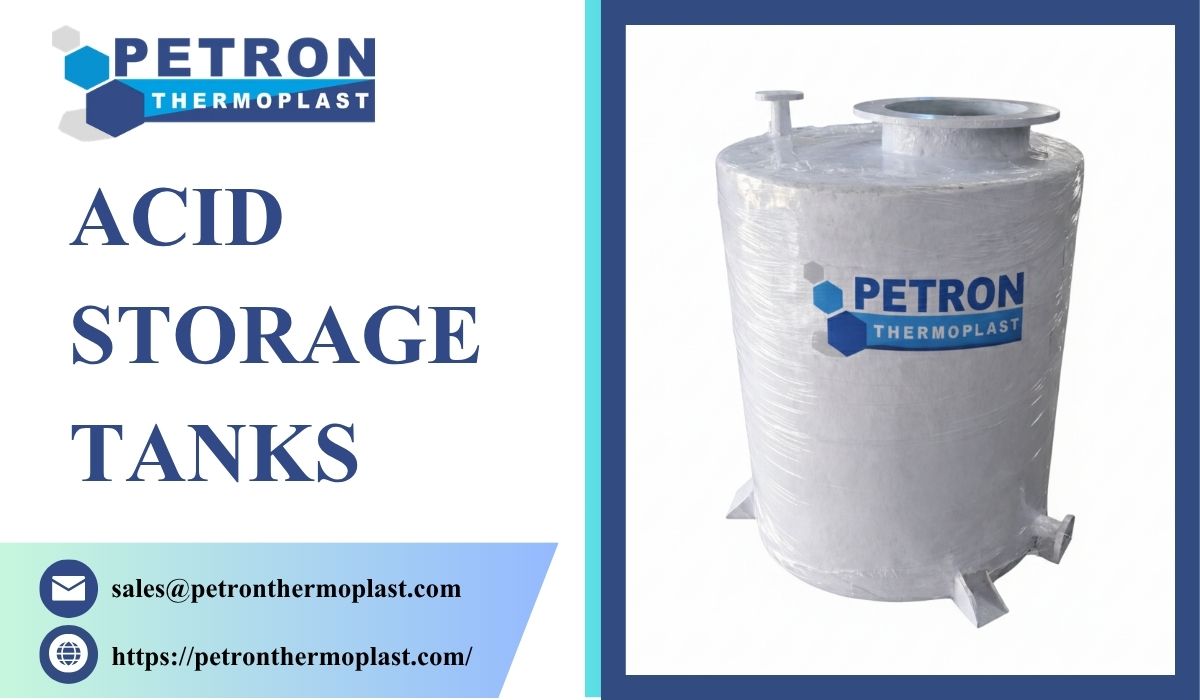
Large-scale chemical plants require storage systems capable of handling acids and other corrosive process chemicals under defined operating conditions. Storage tank selection directly affects chemical handling efficiency, process continuity, maintenance requirements, and overall plant infrastructure. For high-volume chemical operations, an appropriately designed acid storage tank provides a controlled storage solution that can be integrated with transfer pipelines, pumps, dosing systems, and process equipment.
Petron Thermoplast manufactures and supplies custom acid storage tanks for large-scale chemical plants, with configurations developed according to storage capacity, chemical compatibility, tank dimensions, connection requirements, installation conditions, and project specifications. Thermoplastic tank construction can be suitable for many compatible corrosive chemical applications where conventional materials may be affected by corrosion.
What Is an Acid Storage Tank?
An acid storage tank is an industrial tank designed to store acids and compatible corrosive chemicals before they are transferred to production, treatment, dosing, or other process systems.
Depending on the application, acid storage tanks may be used for:
- Bulk acid storage
- Chemical process storage
- Acid transfer operations
- Chemical dosing systems
- Water treatment
- Wastewater treatment
- Metal finishing
- Surface treatment
- Chemical manufacturing
- Industrial process plants
Why Large Chemical Plants Need Custom Acid Storage Tanks?
Large chemical plants can have significantly higher chemical consumption than small industrial facilities. Storage capacity must therefore be planned around production requirements, chemical delivery schedules, transfer rates, available installation space, and operational safety requirements.
A custom tank can be designed around specific project parameters such as:
- Required storage capacity
- Tank diameter
- Overall height
- Chemical type
- Chemical concentration
- Specific gravity
- Operating temperature
- Filling and discharge arrangement
- Inlet and outlet locations
- Vent requirements
- Level measurement
- Drain arrangement
- Installation location
Material Selection for Acid Storage
Material selection is one of the most important considerations when specifying an acid storage tank.
Different acids have different chemical characteristics. Therefore, a tank material that performs well with one chemical may not necessarily be appropriate for another.
Common material considerations may include:
- PP
- PPH
- HDPE
- PVDF
- FRP
- Composite constructions
Acid Storage Tank for Corrosive Chemical Handling
Corrosive chemicals can create significant challenges for metallic storage systems. Material degradation may lead to leakage, maintenance requirements, and reduced service life.
Thermoplastic materials are widely considered for compatible chemical storage applications because they do not experience conventional metal rusting and can provide resistance to many corrosive chemicals.
However, chemical compatibility must always be verified before final tank selection.
Important factors include:
- Acid concentration
- Storage temperature
- Chemical purity
- Exposure duration
- Tank dimensions
- Mechanical loading
- Environmental conditions
Large Capacity Acid Storage Tank Design
Large chemical plants may require tanks ranging from moderate capacity to very large storage volumes.
As tank capacity increases, engineering considerations become more important.
The design may need to consider:
- Tank geometry
- Wall thickness
- Structural reinforcement
- Support arrangement
- Nozzle loading
- Wind conditions
- Seismic conditions where applicable
- Foundation requirements
- Access requirements
- Maintenance clearance
Custom Tank Dimensions
Industrial sites frequently have limited installation space. A tank must therefore fit within the designated plant area while providing the required storage volume.
Custom fabrication can accommodate requirements involving:
- Tank diameter
- Tank height
- Orientation
- Nozzle positioning
- Access openings
- Support structures
- Level indicator arrangements
- Drain connections
- Overflow connections
Acid Storage Tank With Level Measurement
Accurate monitoring of chemical inventory is important in large-scale plants.
An acid storage tank may incorporate a level measurement arrangement based on the process requirements.
Possible options include:
- Level indicators
- Level gauges
- Float-based arrangements
- Electronic level transmitters
- Customized level measurement systems
Tank Nozzle and Connection Configuration
Industrial acid storage tanks may require multiple connections for filling, transfer, venting, drainage, instrumentation, and overflow management.
Typical connections may include:
- Inlet nozzle
- Outlet nozzle
- Drain nozzle
- Overflow connection
- Vent connection
- Level indicator connection
- Manway
- Inspection opening
- Instrumentation connections
Acid Storage Tank for Chemical Transfer Systems
A storage tank is generally part of a larger chemical handling system.
A typical arrangement may be:
Acid Storage Tank → Isolation Valve → Pump → Check Valve → Pipeline → Process Equipment
The tank outlet can be connected to a suitable transfer pump, while valves and strainers can be installed according to the process design.
Applications in Large-Scale Chemical Plants
Chemical Manufacturing
Chemical production facilities require storage tanks for raw materials, intermediates, treatment chemicals, and finished process chemicals.
Water Treatment Plants
Acids may be used for pH adjustment, regeneration, cleaning, or other treatment processes.
Wastewater Treatment
Industrial wastewater facilities may use acids for neutralization and process treatment.
Metal Finishing
Pickling, cleaning, etching, and surface treatment operations may require dedicated acid storage systems.
Fertilizer and Process Industries
Large-scale process facilities can require bulk chemical storage infrastructure to maintain continuous production.
Acid Storage Tank for Bulk Chemical Storage
Bulk storage reduces the frequency of chemical deliveries and can support continuous plant operation.
However, large-volume storage requires proper planning of:
- Tank capacity
- Chemical delivery frequency
- Transfer equipment
- Tank location
- Secondary containment
- Ventilation
- Access
- Emergency arrangements
- Inspection and maintenance
Secondary Containment
Large chemical storage systems should include appropriate containment measures to manage accidental leakage or spills.
Depending on the project design, this may involve:
- Bund walls
- Containment tanks
- Secondary containment areas
- Leak detection
- Drainage management
The containment system should be engineered according to applicable site requirements, chemical characteristics, and local regulations.
Installation Considerations
Correct installation is essential for large acid storage tanks.
Before installation, verify:
- Foundation dimensions.
- Tank capacity.
- Tank orientation.
- Chemical compatibility.
- Nozzle locations.
- Piping alignment.
- Tank support.
- Vent arrangement.
- Level measurement system.
- Secondary containment.
- Access for inspection.
- Maintenance clearance.
Inspection and Maintenance
Regular inspection helps maintain the integrity of chemical storage equipment.
Inspection activities can include:
- Visual inspection of the tank
- Checking external surfaces
- Inspecting nozzles
- Checking connections
- Inspecting supports
- Monitoring leakage
- Checking level measurement equipment
- Inspecting associated piping
- Reviewing operating conditions
Why Choose Petron Thermoplast?
Petron Thermoplast supplies fabricated thermoplastic tanks and industrial piping components for chemical handling applications.
The product range includes:
- Acid Storage Tanks
- Sulfuric Acid Storage Tanks
- HCL Storage Tanks
- Chemical Storage Tanks
- HDPE Chemical Tanks
- PPH Chemical Tanks
- PVDF Chemical Tanks
- PP FRP Storage Tanks
- Double Wall Chemical Tanks
- Bund and Containment Tanks
- Custom Fabricated Thermoplastic Equipment
Selecting the Right Acid Storage Tank
Before purchasing an acid storage tank, buyers should provide detailed process information.
Essential specifications include:
| Specification | Information Required |
| Chemical | Exact acid or chemical name |
| Concentration | Chemical concentration |
| Capacity | Required tank volume |
| Operating temperature | Minimum and maximum temperature |
| Specific gravity | Chemical density |
| Tank orientation | Vertical/horizontal as required |
| Dimensions | Available installation space |
| Connections | Inlet, outlet, drain, vent, overflow |
| Level measurement | Required instrumentation |
| Installation | Indoor/outdoor and site conditions |
| Quantity | Number of tanks required |
Conclusion
Buy Acid Storage Tank for Large Scale Chemical Plants when your facility requires dedicated storage infrastructure for compatible acids and corrosive process chemicals. A properly engineered tank can be integrated with transfer pumps, thermoplastic piping, valves, strainers, instrumentation, and containment systems to create a complete chemical handling arrangement.
For large industrial projects, tank selection should be based on chemical compatibility, concentration, temperature, capacity, dimensions, structural requirements, connection configuration, and installation conditions. Custom fabrication allows the tank to be adapted to the specific requirements of a chemical plant rather than relying on a generic storage configuration.
Petron Thermoplast provides custom-fabricated acid storage tanks for chemical processing, water treatment, wastewater treatment, metal finishing, and other industrial applications. For project enquiries, provide the acid type, concentration, required capacity, operating temperature, tank dimensions, and connection requirements to develop an appropriate storage tank specification.