

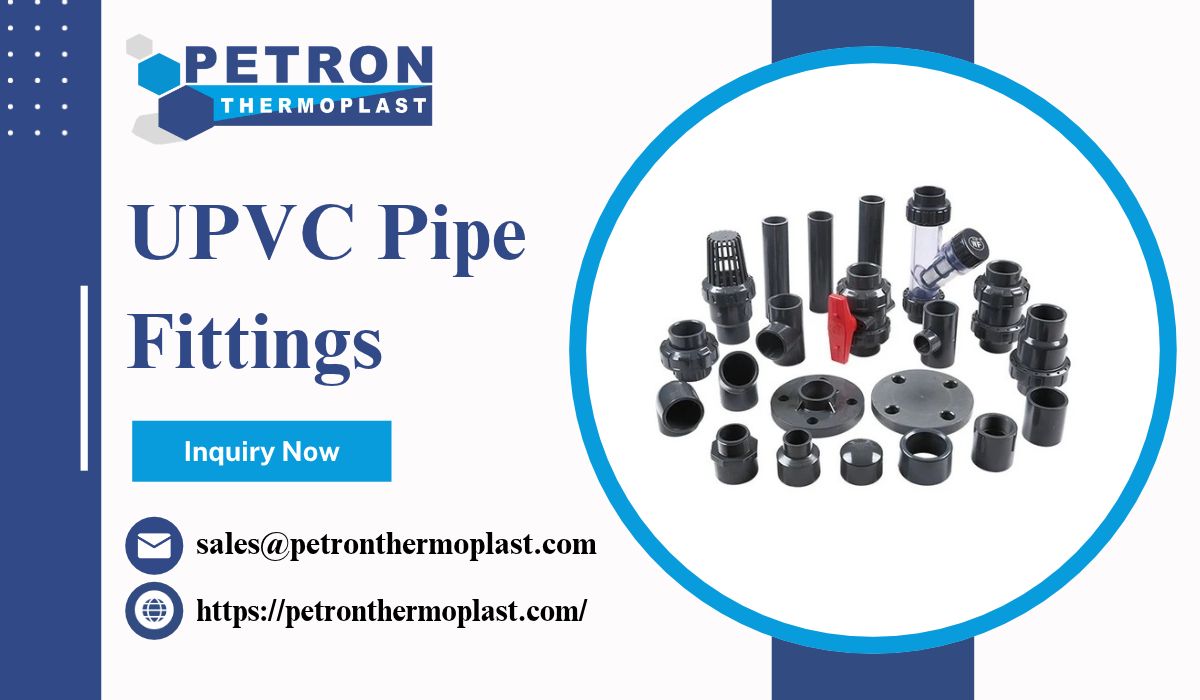
Large-scale industrial projects require reliable piping systems that can support continuous fluid transportation, efficient operations and long-term performance. Selecting suitable pipe fittings is an important part of designing these systems. UPVC pipe fittings are widely used in industrial water distribution, chemical processing, water treatment and various other applications because of their corrosion resistance, lightweight construction and ease of installation.
For projects involving extensive pipeline networks, choosing the right UPVC fittings helps maintain proper connections, manage flow direction and simplify maintenance. Petron Thermoplast offers UPVC pipe fitting solutions for industrial requirements, with options to meet different pipeline configurations, sizes and project specifications.
What Are UPVC Pipe Fittings?
UPVC stands for Unplasticized Polyvinyl Chloride. It is a rigid thermoplastic material commonly used in piping systems for transporting water and compatible industrial fluids.
UPVC pipe fittings are connecting components designed to join pipes, change pipeline direction, create branch connections, reduce pipe diameters and close pipeline ends. They are available in different shapes, dimensions and connection configurations.
These fittings are particularly useful in applications where corrosion resistance, low maintenance and easy handling are important considerations.
Why Choose UPVC Pipe Fittings for Large-Scale Industrial Projects?
Industrial installations often involve long pipeline routes, multiple connection points and different operating conditions. UPVC fittings offer several advantages when selected according to the application’s requirements.
- Corrosion Resistance
Unlike conventional metal fittings, UPVC does not rust or corrode. This makes it suitable for many water distribution and compatible chemical-handling applications. However, chemical compatibility should always be checked against the actual fluid, concentration and operating temperature.
- Lightweight Construction
UPVC fittings are lighter than many metal alternatives. Their manageable weight makes transportation, storage and installation easier, especially when a project requires a large quantity of components.
- Smooth Internal Surface
The smooth internal surface supports efficient fluid movement and can help reduce friction losses. Correct fitting selection and pipeline design remain important for maintaining the required flow rate.
- Low Maintenance Requirements
UPVC does not require painting or rust protection. When properly selected and installed, these fittings can help reduce routine maintenance requirements in suitable operating environments.
- Easy Installation
Depending on the product design, UPVC fittings can be connected using solvent cement or other specified joining methods. Following the manufacturer’s installation instructions is essential for reliable joints.
Types of UPVC Pipe Fittings for Industrial Applications
Different industrial pipeline layouts require different fitting configurations. Some commonly used types include:
UPVC Elbow
UPVC elbows change the direction of fluid flow within a pipeline. They are commonly available in 45-degree and 90-degree configurations, depending on the product range. They are used in water distribution, treatment plants and industrial piping networks.
UPVC Tee
A UPVC tee creates a branch connection from the main pipeline. Equal tees connect pipes of similar diameters, while reducing tees allow connections between different pipe sizes.
UPVC Reducer
Reducers connect pipes with different diameters. They are useful when a pipeline transitions from a larger section to a smaller one or vice versa. Available designs may include concentric and eccentric configurations.
UPVC Coupling
Couplings connect two pipe sections of compatible dimensions. They are commonly used in pipeline extensions, repairs and new installations.
UPVC Union
A union provides a detachable connection that makes it easier to remove or replace equipment without cutting the pipeline. It can be useful around pumps, valves and other maintenance points.
UPVC End Cap
End caps close the open ends of pipelines. They are used in pipeline termination, testing arrangements and selected maintenance applications.
UPVC Flange
Flanged fittings provide bolted connections between pipeline sections or equipment. They are useful where dismantling and maintenance access are required.
Applications of UPVC Pipe Fittings in Large-Scale Projects
UPVC fittings are used in several industrial and infrastructure sectors where their material properties suit the operating conditions.
Water Treatment Plants: Used in suitable water distribution, filtration and treatment pipeline arrangements.
Chemical Processing Industries: Applied in compatible chemical transfer systems where the fluid and operating conditions are suitable for UPVC.
Industrial Manufacturing Units: Used for utility water distribution and selected process piping requirements.
Agricultural Irrigation: Suitable for certain water supply and irrigation networks.
Pharmaceutical Facilities: Used in selected utility and water distribution systems where the required material and hygiene specifications are met.
Electroplating Industries: Can be considered for compatible liquid handling and supporting pipeline arrangements.
Infrastructure Projects: Used in water distribution and other suitable underground or above-ground piping installations, subject to project design requirements.
Key Benefits of Bulk UPVC Pipe Fittings Procurement
Large-scale industrial projects may require hundreds or thousands of fittings in different sizes and configurations. Planning bulk procurement helps project teams manage materials and coordinate installation schedules.
Important benefits include:
- Better coordination of project material requirements.
- Consistent product specifications across pipeline sections.
- Simplified inventory and procurement planning.
- Availability of multiple fitting configurations through planned orders.
- Easier coordination between engineering, purchasing and installation teams.
- Opportunities to discuss project-specific customization and commercial requirements.
How to Select the Right UPVC Pipe Fittings?
Choosing suitable fittings requires careful evaluation of the pipeline’s design and operating environment.
- Understand the application: Identify whether the pipeline will transport water, chemicals or another compatible fluid.
- Confirm pipe dimensions: Match the fitting size with the connected pipe and required connection standard.
- Check operating pressure: Select fittings with an appropriate pressure rating for the complete system.
- Evaluate temperature: Confirm that the material is suitable for the minimum and maximum operating temperatures.
- Verify chemical compatibility: Review the fluid’s composition and concentration before selecting UPVC.
- Choose suitable configurations: Identify elbows, tees, reducers and other fittings based on the pipeline layout.
- Review installation requirements: Follow the recommended joining procedures to avoid leakage and connection problems.
Why Choose Petron Thermoplast for UPVC Pipe Fitting Requirements?
Petron Thermoplast focuses on plastic piping products and industrial solutions for different project requirements. We understand that large-scale installations need suitable fitting configurations, consistent specifications and proper procurement coordination.
Customers can discuss their UPVC pipe fitting requirements based on:
- Different fitting types and configurations.
- Required dimensions and connection arrangements.
- Industrial pipeline applications.
- Project-specific quantity requirements.
- Customized product requirements, subject to technical feasibility.
- Bulk order and export enquiries.
Customized UPVC Pipe Fittings for Industrial Projects
Every industrial pipeline has different design requirements. Some projects need standard fittings, while others require specific dimensions, connection arrangements or configurations.
When requesting customized UPVC pipe fittings, share the technical drawing, required quantity, pipe dimensions, operating pressure, temperature and fluid details. This information helps evaluate product suitability and manufacturing or procurement feasibility. Early coordination between the project engineer and purchasing team can also help reduce material selection errors and installation delays.
Conclusion
The best UPVC pipe fittings for large-scale industrial projects are those that match the pipeline design, operating conditions and application requirements. Elbows, tees, reducers, couplings, unions, flanges and end caps each serve an important purpose in creating an efficient piping network.
Their corrosion resistance, lightweight construction and convenient installation make UPVC fittings a practical choice for many suitable industrial applications. However, correct material selection, pressure assessment, chemical compatibility and installation practices are essential for dependable performance. Petron Thermoplast supports industrial customers with UPVC pipe fitting solutions for different project requirements. Contact our team to discuss product details, customized requirements and bulk order enquiries.