

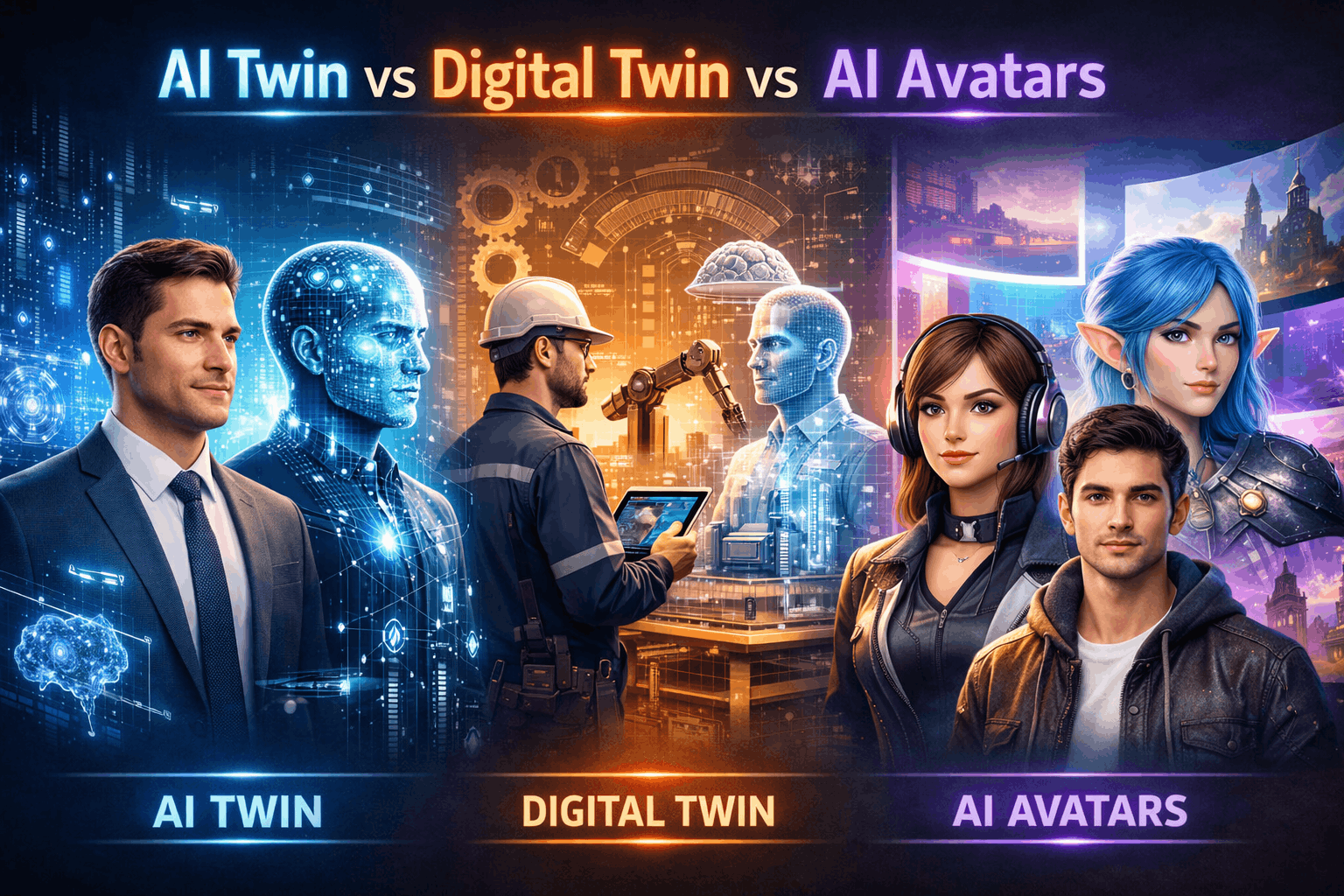
As artificial intelligence continues to evolve, terms like AI Twin, Digital Twin, and AI Avatars are becoming increasingly common across industries such as marketing, manufacturing, healthcare, and content creation. While these terms may sound similar, they serve very different purposes and are built using distinct technologies.
Understanding the difference between AI Twins, Digital Twins, and AI Avatars is crucial for businesses, creators, and marketers looking to adopt the right solution for automation, personalization, or simulation.
In this article, we’ll break down each concept in simple terms, explore its key differences, real-world use cases, and help you decide which one fits your needs best.
What Is an AI Twin?
An AI Twin is an intelligent virtual replica of a real person or entity that can think, speak, act, and respond like the original using artificial intelligence. Unlike static representations, AI Twins are dynamic and interactive.
AI Twins are typically created using:
-
Machine learning
-
Natural language processing (NLP)
-
Voice synthesis
-
Facial animation
-
Behavioral modeling
In many cases, an AI Twin can be generated from just a photo, voice sample, or short video, making it highly scalable for content creation.
Key Characteristics of AI Twins
-
Mimics human personality and communication style
-
Can generate videos, voiceovers, or conversations
-
Learns and improves over time
-
Operates independently once trained
Common Use Cases of AI Twins
-
AI-generated video ads
-
Personal brand cloning
-
Customer support representatives
-
Multilingual video marketing
-
Influencer and UGC-style content creation
AI Twins are especially popular in marketing, sales, and content automation, where personalization and speed matter.
What Is a Digital Twin?
A Digital Twin is a virtual model of a physical object, system, or process, designed to simulate real-world behavior using real-time data. Digital Twins are not focused on human interaction but rather on monitoring, analysis, and optimization.
They are widely used in industries such as manufacturing, engineering, construction, and healthcare.
Digital Twins rely on:
-
IoT sensors
-
Real-time data streams
-
Physics-based simulations
-
Predictive analytics
Key Characteristics of Digital Twins
-
Represents physical assets or systems
-
Continuously updated with real-world data
-
Used for testing, monitoring, and optimization
-
Focused on performance, not communication
Common Use Cases of Digital Twins
-
Smart factories and manufacturing optimization
-
Predictive maintenance of machinery
-
City planning and infrastructure modeling
-
Healthcare simulations (organs, devices)
-
Energy and supply chain optimization
Digital Twins help organizations predict failures, reduce costs, and improve efficiency by simulating real-world scenarios before they happen.
What Is an AI Avatar?
An AI Avatar is a virtual character designed primarily for visual representation and basic interaction. AI Avatars may look human-like or cartoonish, but they usually lack deep intelligence or learning capabilities compared to AI Twins.
AI Avatars are commonly used in:
-
Explainer videos
-
Virtual assistants
-
Educational content
-
Gaming and metaverse platforms
They often follow predefined scripts and responses.
Key Characteristics of AI Avatars
-
Visual or animated digital characters
-
Limited intelligence or adaptability
-
Script-driven or rule-based behavior
-
Focused on appearance and presentation
Common Use Cases of AI Avatars
-
Website guides and chat avatars
-
E-learning videos
-
Virtual presenters
-
Metaverse and gaming characters
-
Brand mascots
AI Avatars are ideal when visual engagement matters more than realism or autonomy.
AI Twin vs Digital Twin vs AI Avatars: Core Differences
Let’s compare all three concepts side by side to clearly understand their differences.
Purpose and Functionality
-
AI Twin: Designed to replicate human behavior, communication, and intelligence
-
Digital Twin: Built to simulate physical systems and processes
-
AI Avatar: Created mainly for visual representation and basic interaction
Intelligence Level
-
AI Twin: High intelligence with learning and adaptation
-
Digital Twin: Data-driven intelligence focused on prediction
-
AI Avatar: Low to moderate intelligence, often scripted
Interaction Capability
-
AI Twin: Can speak, respond, and act autonomously
-
Digital Twin: Limited interaction, mainly data analysis
-
AI Avatar: Basic interaction or pre-recorded responses
Data Dependency
-
AI Twin: Uses behavioral and conversational data
-
Digital Twin: Relies on real-time sensor and IoT data
-
AI Avatar: Minimal data dependency
Key Differences Explained in Detail
AI Twin vs Digital Twin
The biggest difference between an AI Twin and a Digital Twin lies in what they replicate.
-
AI Twins replicate people or personalities
-
Digital Twins replicate machines, systems, or environments
AI Twins are communication-focused, while Digital Twins are optimization-focused.
AI Twin vs AI Avatars
AI Twins are far more advanced than AI Avatars.
-
AI Twins can adapt, learn, and create content independently
-
AI Avatars usually follow fixed scripts or limited commands
If realism and personalization matter, AI Twins are the better choice.
Digital Twin vs AI Avatars
These two are used in entirely different domains.
-
Digital Twins focus on engineering and analytics
-
AI Avatars focus on visuals and user engagement
Real-World Examples
Example of an AI Twin
A brand creates an AI Twin of its founder to generate:
-
Product explainer videos
-
Multilingual ad campaigns
-
Personalized video messages
The AI Twin delivers consistent messaging without repeated filming.
Example of a Digital Twin
A manufacturing company uses a Digital Twin of its production line to:
-
Predict machine failure
-
Optimize energy consumption
-
Test process improvements virtually
Example of an AI Avatar
An e-learning platform uses an AI Avatar as a virtual instructor to:
-
Present lessons
-
Guide users through courses
-
Maintain consistent branding
Which One Should You Choose?
The right choice depends on your goals.
Choose AI Twin if you want to:
-
Scale video content quickly
-
Create human-like brand representation
-
Personalize marketing and communication
-
Automate UGC-style video creation
Choose Digital Twin if you need to:
-
Monitor physical assets
-
Improve operational efficiency
-
Run simulations and predictions
-
Optimize complex systems
Choose AI Avatar if you want to:
-
Add visual appeal to content
-
Create simple explainer videos
-
Build virtual brand characters
-
Enhance user engagement
Role of AI Twins in Modern Marketing
AI Twins are rapidly transforming video marketing and advertising. Brands can now create hundreds of videos without cameras, actors, or studios. AI Twins also enable:
-
Consistent brand messaging
-
Faster campaign execution
-
Cost-effective global scaling
-
Multilingual content production
This makes AI Twins particularly valuable for eCommerce, D2C brands, and performance marketers.
Future of AI Twins, Digital Twins, and AI Avatars
As AI technology advances, the lines between these concepts may blur, but their core purposes will remain distinct.
-
AI Twins will become more emotionally intelligent and realistic
-
Digital Twins will integrate deeper predictive and real-time analytics
-
AI Avatars will evolve visually but remain presentation-focused
Together, these technologies will shape the future of automation, personalization, and digital experiences.
Final Thoughts
While AI Twin, Digital Twin, and AI Avatars may sound similar, they serve very different roles across industries.
-
AI Twins replicate people and intelligence
-
Digital Twins replicate systems and physical assets
-
AI Avatars replicate appearance and basic interaction
Understanding these differences helps businesses adopt the right technology and unlock maximum value.
If your goal is human-like communication, scalable video content, and personalized marketing, AI Twins are the clear winner.