

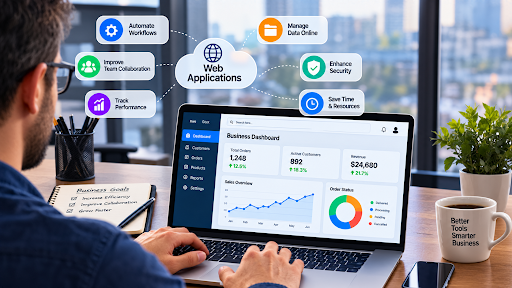
Farhan Siddiqui manages operations at a sporting goods exporter in Sialkot, and for years his week revolved around a spreadsheet nobody dared to touch. It tracked orders, stitching schedules, packing lists, and shipping dates for buyers in the US and UK. If two people opened it at once, someone lost an hour of work. If a buyer asked where their shipment stood, Farhan dug through emails. Then his team moved the whole workflow into a browser-based system that every department could use at the same time. Orders had statuses, buyers had their own login to check progress, and the spreadsheet finally retired.
That kind of change is why owners now search for a Web Application Development Company the way they once searched for an accountant or a lawyer. Web apps run in a browser, need no installation, and update for everyone at once. They’ve quietly become the backbone of everyday operations in businesses of every size. This guide explains how they work, where they make the biggest difference, what to watch for, and how to judge whether one is worth building.
Web Apps, Websites, and Desktop Software: What’s the Difference?
People often blur these terms, so a quick clarification helps.
A website mostly presents information. A restaurant’s menu page or a law firm’s profile is a good example. A web application lets users do things: log in, enter data, run reports, approve requests, and collaborate. Gmail, Trello, Shopify’s admin panel, QuickBooks Online, and Salesforce are all web apps. A desktop program is installed on a specific computer and often needs manual updates.
The browser-based model changed business software in three major ways. First, nothing needs installing, so a new employee can start work from any device with a login. Second, updates roll out centrally, which means everyone uses the same version and security fixes arrive instantly. Third, data lives in one place instead of scattered across laptops.
For small and mid-sized companies without large IT teams, that combination is a relief. Fewer machines to maintain, fewer version mismatches, and fewer lost files.
Why Businesses Keep Moving Into the Browser
Several trends pushed companies this way.
Remote and hybrid work. When teams work from homes, branch offices, and client sites, software has to work anywhere. Web apps do.
Cloud infrastructure. Platforms like Amazon Web Services, Microsoft Azure, and Google Cloud made reliable hosting affordable. A small company can now run systems that once demanded a server room.
Better technology. Modern frameworks such as React, Angular, Vue, and Next.js on the front end, and Node.js, Django, Laravel, Ruby on Rails, and .NET on the back end, make rich, fast interfaces possible. Web apps now feel closer to desktop software than to old web pages.
Integration culture. Most web apps offer APIs, so tools can talk to each other. Stripe handles payments, Slack handles messages, and QuickBooks handles accounting, all feeding data into one workflow.
Speed of change. Business needs shift constantly. Web apps can be adjusted and released in days or weeks, not months.
A Quick Look Behind the Screen
If you’re new to this, you might wonder what is web development in practical terms. It’s the craft of building software that runs in a browser. The front end covers what people see and click, including layouts, forms, and charts. The back end handles the logic and data, such as storing orders, checking permissions, and calculating prices. Databases like PostgreSQL, MySQL, and MongoDB keep information organized, while servers and cloud services keep everything available.
Good web apps also depend on less visible work: security, performance tuning, testing, and monitoring. That’s why a polished app feels effortless, and a rushed one feels clumsy.
Inventory, Orders, and Supply Chain
For product-based businesses, inventory is where mistakes get expensive. Overstock ties up cash, and stockouts lose sales.
Web-based inventory systems update stock levels as items are received, sold, or moved between locations. Barcode scanning through phone cameras or handheld devices feeds data into the same system. Alerts warn when stock falls below a set level, and reports show which products move slowly.
For Farhan, the biggest gain came from order tracking. Each purchase order moved through clear stages: materials sourced, cutting, stitching, quality check, packing, shipped. Managers saw bottlenecks instantly, and buyers could log in to check status without emailing. Questions that used to eat hours each week dropped to a handful.
Procurement benefits as well. Approvals, supplier records, and purchase histories live in one place, which makes audits and negotiations far easier.
Sales, Customers, and Relationships
Customer relationship management systems are among the most widely used web apps. Salesforce, HubSpot, Zoho, and Pipedrive track leads, conversations, deals, and follow-ups. Instead of storing contacts in personal notebooks, the whole team shares one record of every interaction.
That continuity matters. When a salesperson leaves, their pipeline doesn’t vanish. When a customer calls with a problem, anyone can see their history and respond intelligently.
Customer portals take it further. Clients can log in to view invoices, download documents, track orders, or submit support requests. Self-service reduces phone calls and gives customers a sense of control. A buyer in London checking production progress at midnight doesn’t need to wait for Pakistan to wake up.
Finance, Invoicing, and Payments
Accounting software moved to the browser years ago. Xero, QuickBooks Online, and FreshBooks handle invoicing, expense tracking, bank feeds, and tax reports. Payment tools like Stripe and PayPal let customers pay online, and automatic reminders reduce late payments.
Custom web apps often sit on top. A business might build a tool that generates invoices from completed jobs, applies the right tax rules, and syncs with its accounting package. Hours of manual entry shrink to a click.
Accuracy improves too. When data moves directly between systems instead of through copy and paste, typing errors drop. Finance teams spend less time fixing mistakes and more time analyzing numbers.
People, Scheduling, and Workforce Management
Human resources used to mean paper forms and filing cabinets. Web apps handle recruitment pipelines, onboarding checklists, leave requests, performance reviews, and payroll. Employees apply for time off from a phone, managers approve with a tap, and records update automatically.
Shift-based businesses benefit even more. Scheduling tools like Deputy, Homebase, and When I Work let managers build rosters, staff swap shifts, and everyone see changes in real time. Gone are the endless group chats where nobody knows who’s covering Saturday.
Training and compliance also move online. Companies assign courses, track completion, and store certificates, which is especially useful in industries with safety or regulatory requirements.
Workflows, Approvals, and Collaboration
Many everyday delays come from one source: waiting for someone to sign off. Web-based workflow tools route requests to the right person, send reminders, and record decisions.
Project management apps like Asana, Trello, Jira, and Monday.com show who is doing what and by when. Document platforms such as Google Workspace and Microsoft 365 allow several people to edit a file at the same time, with comments and version history. Real-time communication tools like Slack and Microsoft Teams keep conversations connected to the work.
The impact is cultural as much as technical. When progress is visible, teams spend less time in status meetings and more time getting things done.
Dashboards and Data-Driven Decisions
Every business generates data. Few use it well. Web apps connect numbers from sales, inventory, finance, and customer support into dashboards that update live.
Tools like Power BI, Tableau, Looker, and Metabase turn rows of data into charts that managers can read in seconds. Which product lines earn the highest margin? Which customers pay late? Which stage of production runs slowest? Answers appear without waiting for a monthly report.
Custom dashboards focus on what matters to each role. A warehouse manager sees pick rates and stockouts. A sales director sees pipeline value and win rates. A founder sees cash flow and growth. Clear numbers help teams argue less and decide faster.
Integration and Automation
Individual apps help. Connected apps transform. APIs, webhooks, and automation platforms like Zapier and Make link systems so data moves without manual effort.
A new online order can create an invoice, notify the warehouse, update inventory, and email the customer, all within seconds. A signed contract can trigger onboarding tasks. A failed payment can alert the finance team and send the customer a friendly reminder.
Each automated step removes a small chore, and small chores add up. Many companies discover they were spending a surprising portion of each week on repetitive tasks that software can handle.
Progressive Web Apps and Real-Time Features
Progressive web apps blur the line between websites and mobile apps. They load in a browser but can be added to a home screen, send notifications, and work offline using service workers. For field teams, warehouses, or areas with patchy internet, offline support keeps work flowing and syncs once a connection returns.
Real-time features, powered by technologies like WebSockets, let dashboards, chats, and tracking maps update instantly. A dispatcher can see vehicles moving, and a kitchen can see orders appear as customers place them.
Security, Privacy, and Compliance
Moving operations online raises the stakes for security. Good web apps follow practices recommended by the Open Web Application Security Project, known for its OWASP Top 10 list of common risks.
Essentials include HTTPS encryption, strong authentication, multi-factor login, role-based access so people only see what they need, input validation, regular updates, and automated backups. Single sign-on through OAuth or SAML simplifies access for larger teams while keeping control.
Regulations matter too. Companies handling personal data may need to follow GDPR, UK GDPR, or local laws, and some industries require standards like HIPAA, PCI DSS, SOC 2, or ISO 27001. Planning for compliance from the start is far cheaper than fixing gaps later.
AI Is Joining the Toolkit
Artificial intelligence features are showing up in web apps across industries. Chat assistants answer customer questions, forecasting tools predict demand, document readers extract data from invoices, and summarization tools condense long threads.
These tools help most when they support people instead of replacing judgment. Review steps, clear logs, and human approval for important actions keep results trustworthy.
Build, Buy, or Blend?
Not every problem needs custom software. A sensible decision looks like this:
- Buy when a mainstream product already fits your process, such as accounting or email.
- Customize when an existing platform nearly fits and offers extensions or APIs.
- Build when your workflow is unique, gives you a competitive edge, or no tool handles your needs.
- Blend when you combine ready-made tools with a custom layer that ties them together.
Farhan’s company chose the blend. They kept their accounting package, then built a custom order tracking and buyer portal that connected to it. The custom part targeted exactly the pain points off-the-shelf tools missed.
Measuring Whether It’s Working
Software should earn its place. Useful measures include time saved per task, error rates, order processing speed, customer response times, employee adoption, support ticket volume, and revenue impact. Compare numbers before and after launch, and ask staff for honest feedback.
Adoption is the make-or-break factor. A technically perfect app that people avoid is a failure. Training, simple interfaces, and visible benefits help teams embrace change.
Common Mistakes to Avoid
Starting too big. Try a focused first release solving one painful workflow before expanding.
Ignoring users. The people doing the daily work know where the friction lives. Involve them early.
Neglecting maintenance. Web apps need updates, monitoring, and security patches. Budget for them.
Poor data hygiene. Messy data produces messy results. Clean it before migrating.
Skipping documentation and training. Knowledge locked in one person’s head becomes a risk.
Overcomplicating permissions or screens. Simplicity wins.
Frequently Asked Questions
What are web applications used for in business?
They handle inventory, sales, customer management, accounting, scheduling, project tracking, reporting, and customer portals, all accessible through a browser.
How is a web app different from a website?
A website mainly shares information, while a web app lets users perform tasks such as logging in, entering data, and collaborating.
Are web applications secure enough for sensitive business data?
They can be, when built with strong authentication, encryption, access controls, regular updates, and compliance with relevant regulations.
How long does it take to build a custom web app?
A focused first version typically takes two to four months. Larger systems with many integrations can take six months to a year.
Can web apps work without internet?
Progressive web apps can store data locally and sync later, which is useful in areas with unreliable connections.
Do small businesses really need custom web apps?
Not always. Many start with off-the-shelf tools and add custom software when they hit limits that existing products can’t solve.
Final Thoughts
Good business software rarely looks dramatic. Its value shows up in absences: no lost orders, no duplicate entries, no chasing signatures, no wondering where a shipment is. Web applications deliver those absences by putting shared information in front of the right people at the right moment.
Farhan still keeps a copy of the old spreadsheet, mostly as a reminder. When a new hire asks why the company is so particular about entering data properly, he opens it and lets them scroll through the colored cells and mysterious notes. Then he opens the new system, where everything is clear, and lets the comparison do the talking.